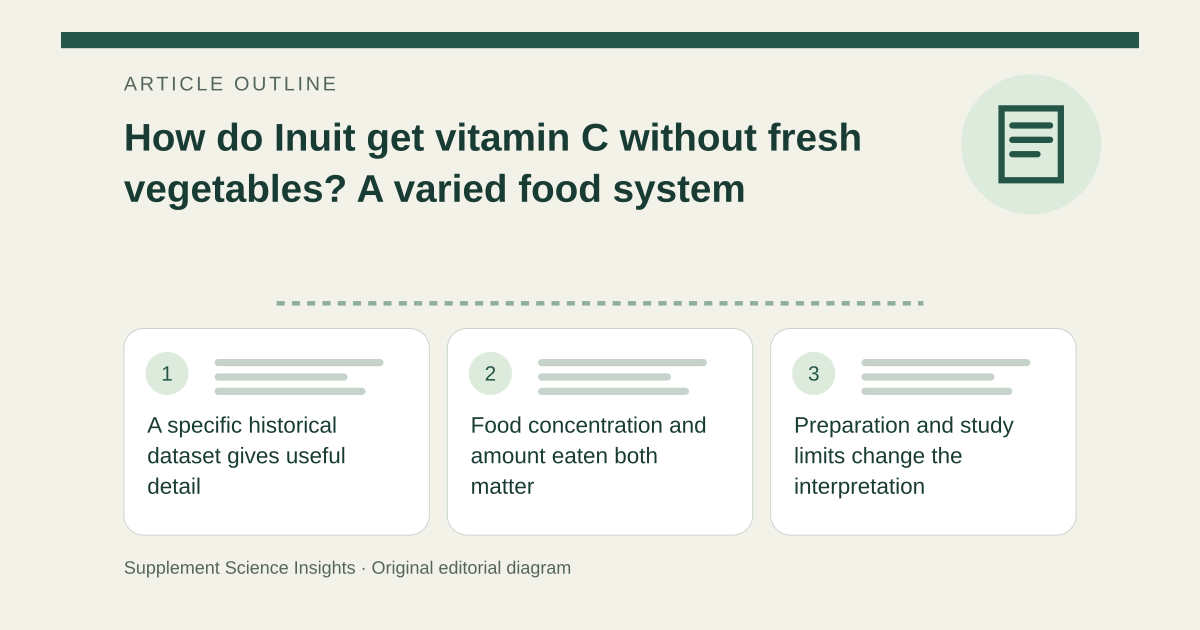
A specific historical dataset gives useful detail
Researchers reanalyzed records collected in East Greenland during 1936-1937. The analysis covered 35 adults in 13 families and estimated individual intake from household food records. It found important contributions from algae and seal foods; narwhal skin and eyes contributed less to overall intake in this particular dataset than popular accounts often imply. [1]
Food concentration and amount eaten both matter
Some organs and marine plants contained more vitamin C than muscle meat in the historical analyses. A food with a relatively high concentration may still contribute little if rarely eaten or consumed in a small portion. The dietary pattern, rather than one celebrated food, determines total intake. [1]
Preparation and study limits change the interpretation
The authors considered losses during cooking and acknowledged uncertainty from allocating household food to individuals and missing food eaten during hunting. Records varied in duration, and this was not a feeding trial or a representative survey of all Inuit communities. The authors declared no conflict; a specific funding statement was not identified in the inspected article. [1]
Avoid the claim that vitamin C is unnecessary
The study does not show that Inuit do not need vitamin C or that scurvy was impossible. NIH describes the human dietary requirement and the effect of storage and cooking on food vitamin C. A historical food system cannot be reduced to a modern prescription to eat only supermarket meat. [2][1]
Apply food-composition reasoning carefully
Imagine comparing a menu of muscle meat alone with a regional diet including organs and marine plants. Calling both meat-based hides important nutrient differences. To assess a present-day diet, use actual foods, preparation and quantities rather than a broad cultural label. [2][1]
| Observation | Limit |
|---|---|
| Algae contributed meaningfully | Specific East Greenland dataset |
| An organ contains vitamin C | Contribution depends on amount eaten |
| Household intake reconstructed | Individual estimates are uncertain |
| Traditional food pattern | Not proof that all restrictive diets are adequate |
Sources for this article
- Vitamin C in East-Greenland traditional nutrition: a reanalysis of the Høygaard nutritional data (1936-1937) - PMC
Source consulted: 2026-09-21. This is a reference resource, not a claim that we conducted the studies or tested a product. - Vitamin C - Health Professional Fact Sheet
Source consulted: 2026-09-21. This is a reference resource, not a claim that we conducted the studies or tested a product.