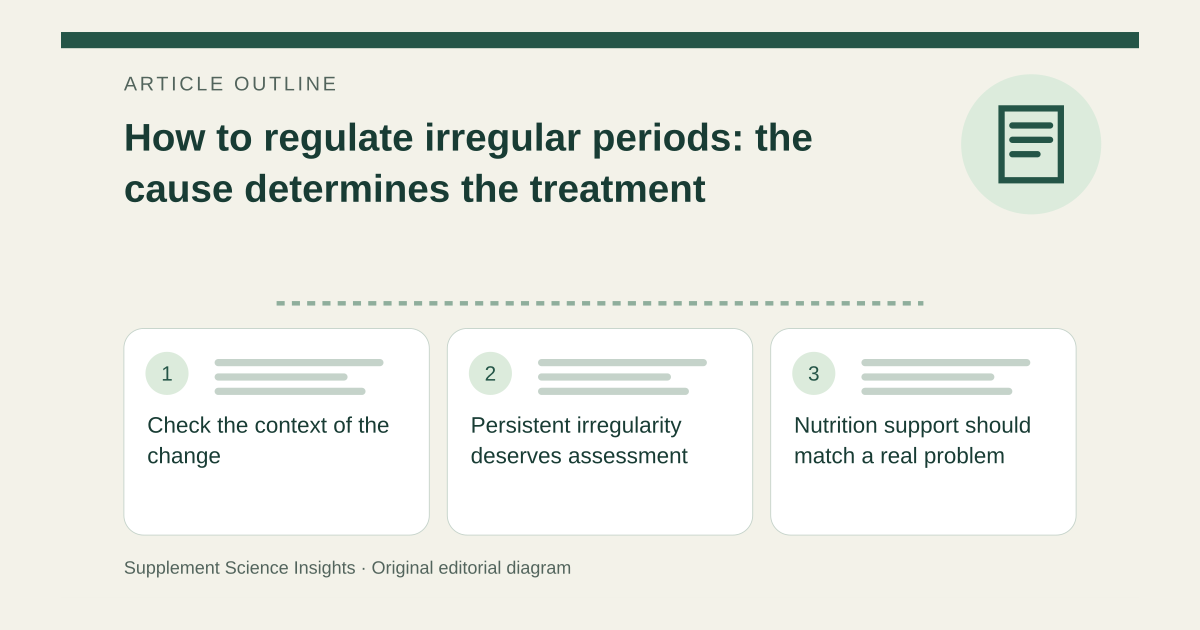
Check the context of the change
NHS guidance lists puberty, the menopause transition, pregnancy, hormonal contraception, major weight changes, stress and excessive exercise among common explanations. A missed period can be an early sign of pregnancy. Tracking dates and recent changes is more informative than guessing a vitamin deficiency. [1]
Persistent irregularity deserves assessment
Seek advice for irregular periods, bleeding between periods, periods lasting more than seven days or irregularity accompanied by other symptoms. Thyroid and ovarian hormone conditions may require investigation. Supplements cannot establish the diagnosis. [1]
Nutrition support should match a real problem
If intake or major weight changes are relevant, discuss a sustainable plan rather than an extreme diet. A supplement can fill a specific nutrient gap, but a nutrient role in normal physiology is not proof that extra doses will normalize cycles. [2][1]
Treatment and fertility goals may differ
Some treatments regulate bleeding; others address thyroid disease or ovulation. Tell the clinician if pregnancy is a goal so the plan fits that objective. A regular bleeding pattern and regular ovulation should not be assumed to be identical. [1][3]
Bring a timeline to the appointment
Imagine periods changed after a new contraceptive or a major exercise increase. Note that change, pregnancy possibility and any other symptoms. The useful next step is a cause-based review, not adding multiple products and losing track of what changed. [1][2]
| Finding | Interpretation |
|---|---|
| Missed period | Consider pregnancy and context |
| New persistent irregularity | Arrange assessment |
| Supplement claim | Does not establish the cause |
Sources for this article
- Irregular periods - NHS
Source consulted: 2026-09-20. This is a reference resource, not a claim that we conducted the studies or tested a product. - Dietary Supplements: What You Need to Know
Source consulted: 2026-09-20. This is a reference resource, not a claim that we conducted the studies or tested a product. - NHS 111 Wales - Health A-Z : Polycystic ovary syndrome
Source consulted: 2026-09-20. This is a reference resource, not a claim that we conducted the studies or tested a product.