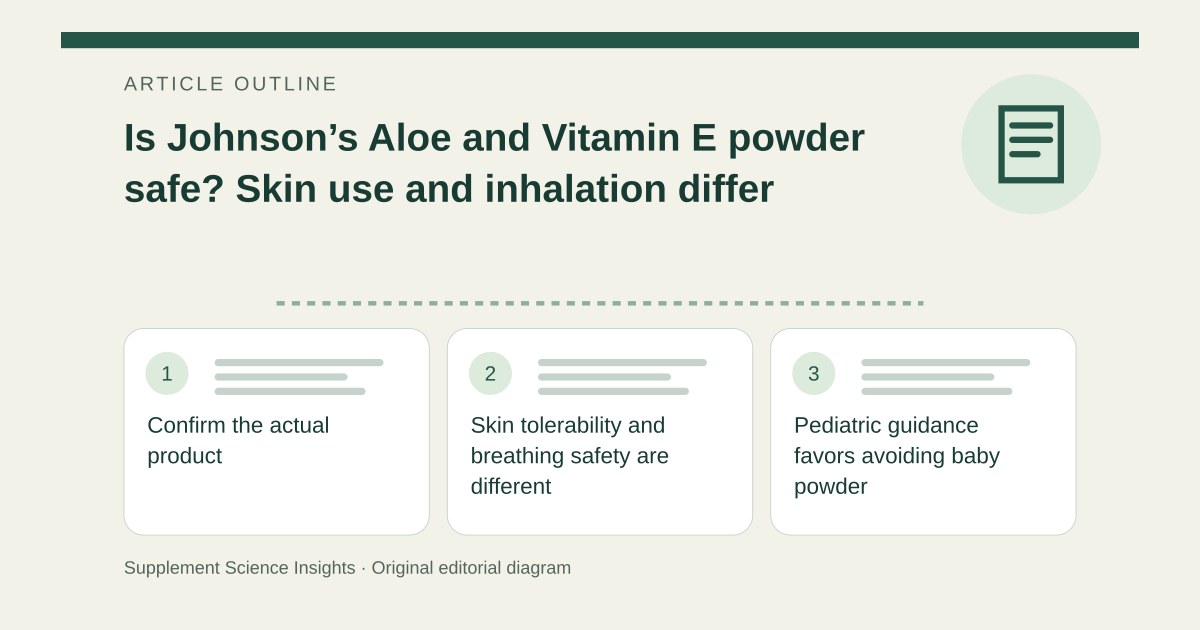
Confirm the actual product
The inspected Canadian manufacturer page identifies cornstarch and describes moisture absorption. It also says website information may differ from the package and advises using the current package information. That supports identifying this formulation, not claiming that every bottle sold under a similar name worldwide is identical. [1]
Skin tolerability and breathing safety are different
The manufacturer warns to keep the powder away from the child’s face, avoid inhalation and eye contact, and use it externally only. Its directions place powder in the adult’s hand away from the face before applying it. Aloe and vitamin E do not negate the particulate inhalation risk. [1]
Pediatric guidance favors avoiding baby powder
AAP HealthyChildren advises avoiding baby powder and notes that cornstarch can still irritate the respiratory tract if inhaled. Talc-free identity therefore answers one composition question without removing all risks. For diaper care, the guidance favors frequent changes, gentle cleaning and a fragrance-free barrier cream when appropriate. [2]
Marketing is not a personalized safety assessment
Terms such as dermatologist-tested or hypoallergenic do not establish that every infant will tolerate a product or that every use is appropriate. Keep the container out of children’s reach, follow warnings and seek advice if skin irritation or breathing symptoms occur. A persistent rash needs assessment rather than repeated powder application. [1][2]
A practical distinction
Imagine a family chooses cornstarch powder to avoid talc but shakes it near the baby’s face. The ingredient change does not make that exposure safe. The pediatric recommendation to avoid baby powder and use simpler diaper-care measures remains relevant. [2][1]
| Question | Answer from inspected sources |
|---|---|
| What is this Canadian formula? | Cornstarch-based |
| Can it be inhaled safely? | No; the label warns against inhalation |
| Does vitamin E remove particle risk? | No |
| What does AAP advise for babies? | Avoid baby powder and use appropriate diaper care |
Sources for this article
- Aloe & Vitamin E Powder| Johnson's® Baby
Source consulted: 2026-09-21. This is a reference resource, not a claim that we conducted the studies or tested a product. - How to Choose Safer Personal Care Products: Tips for Families - HealthyChildren.org
Source consulted: 2026-09-21. This is a reference resource, not a claim that we conducted the studies or tested a product.