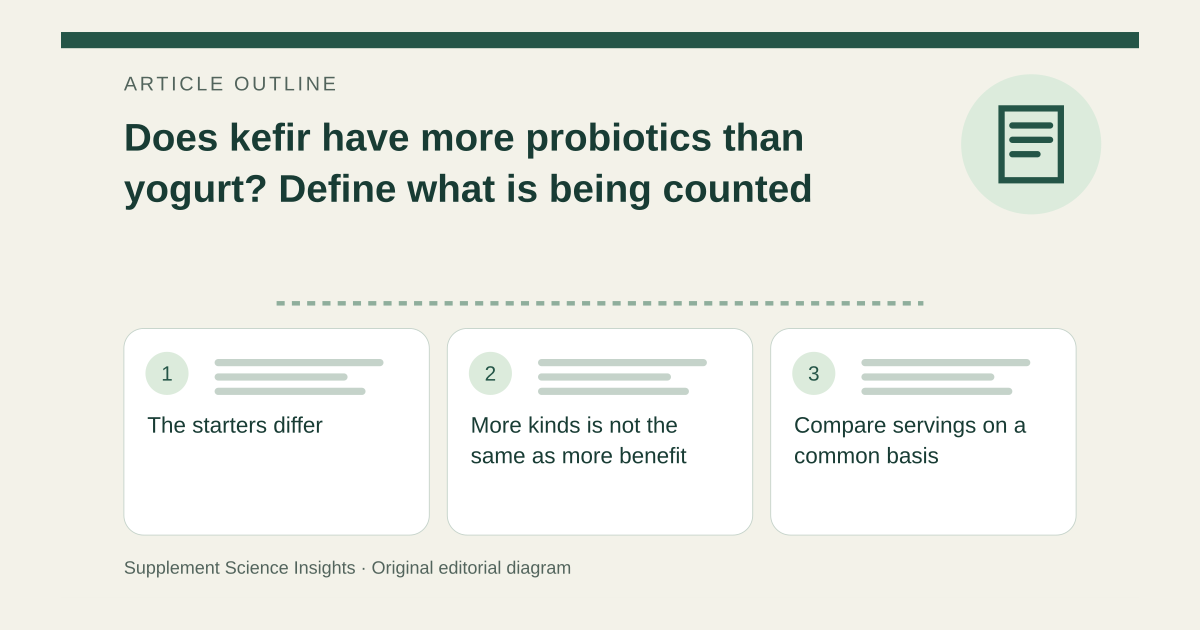
The starters differ
The Codex fermented-milk standard describes defined yogurt starter organisms and a kefir culture that includes bacteria and yeasts. That identity distinction does not specify the exact strain list or live count in every retail serving. Product formulation and processing remain relevant. [1]
More kinds is not the same as more benefit
A diverse community is not automatically a set of clinically validated probiotics. ISAPP distinguishes fermented foods from probiotics with evidence of a health benefit, and ODS emphasizes strain-specific interpretation. Comparing only the number of named microbes misses both quantity and the clinical question. [2][3]
Compare servings on a common basis
Imagine one product gives a count per bottle and another per gram. Convert to the amount actually eaten before comparing, and check whether the counts apply through expiry. If neither identifies clinically studied strains, treat the decision as a food preference and nutritional comparison rather than a proven probiotic ranking. [3]
| Example | Interpretation |
|---|---|
| Microbial diversity | Number of types, not necessarily benefit |
| CFU per serving | Requires comparable portion sizes |
| Clinical evidence | Must match the preparation and outcome |
Sources for this article
- Codex CXS243-2003: Standard for Fermented Milks, amended2024
Source consulted: 2026-09-20. This is a reference resource, not a claim that we conducted the studies or tested a product. - The International Scientific Association for Probiotics and Prebiotics (ISAPP) consensus statement on fermented foods | Nature Reviews Gastroenterology & Hepatology
Source consulted: 2026-09-20. This is a reference resource, not a claim that we conducted the studies or tested a product. - Probiotics - Health Professional Fact Sheet
Source consulted: 2026-09-20. This is a reference resource, not a claim that we conducted the studies or tested a product.