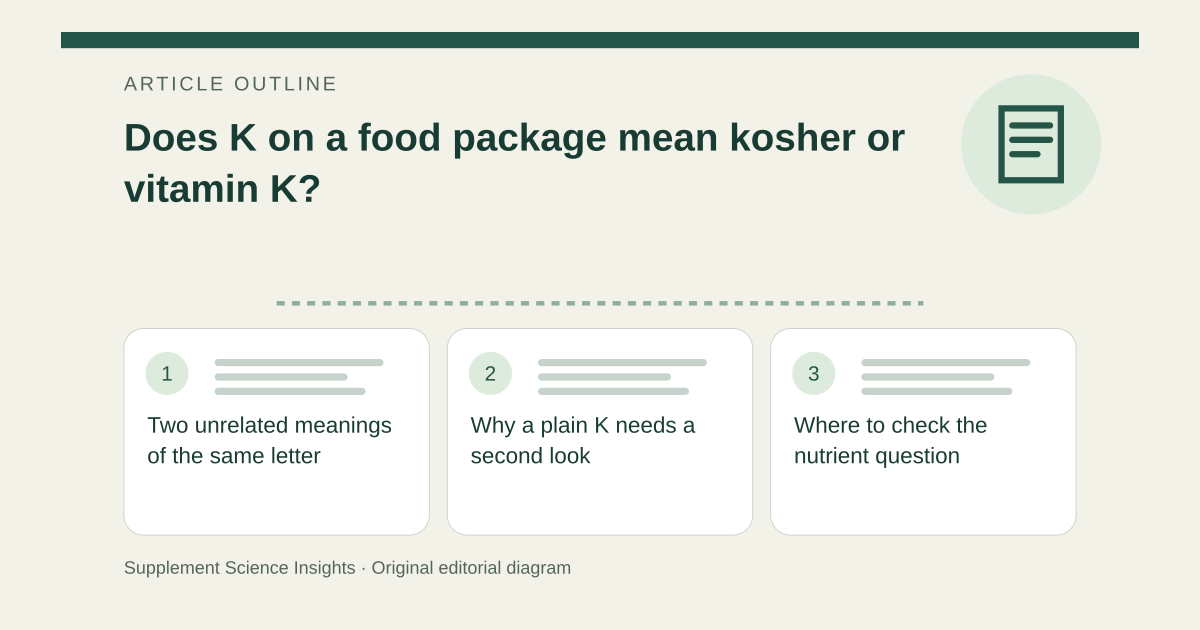
Two unrelated meanings of the same letter
A K used as a kosher mark concerns the food's religious certification or a kosher claim. Vitamin K is a family of nutrients that includes vitamin K1 and forms of vitamin K2. One use of the letter does not establish the other. [1][2]
Look at the context. A logo near certification marks is serving a different purpose from “vitamin K” beside a nutrient amount. A food can carry a kosher mark without claiming to be a source of vitamin K. Similarly, listing vitamin K says nothing by itself about kosher supervision. [1][2]
Why a plain K needs a second look
OU Kosher explains that a generic K does not, by itself, identify who provides supervision. Its guidance recommends establishing which rabbi or agency stands behind the mark and obtaining certification information from the manufacturer. [1]
A distinctive certifier's logo is more informative about identity than an unexplained letter. The relevant question is still whether that certification actually applies to the product in hand. Avoid treating a generic mark as evidence of a specific agency's current oversight. [1]
Where to check the nutrient question
To investigate vitamin K, look for the full nutrient name and reliable composition information. Vitamin K1 is phylloquinone, and vitamin K2 refers to menaquinones. The letter in a kosher logo does not give an amount of either. [2][1]
The same separation applies to health claims. Kosher certification is not a vitamin-content test or a demonstration of clinical benefit. Nutrient information is not religious certification. Keeping those questions separate is enough to resolve most of the apparent ambiguity. [2][1]
Reading a hypothetical package
Imagine a cereal box with a K near the brand name and a separate nutrition panel. To check kosher status, identify the certifier. To check vitamin K content, use the nutrient information or an appropriate food-composition source. Do not assign a vitamin amount from the size or prominence of the letter. [1][2]
| Element | Question it can address |
|---|---|
| Kosher mark | What certification or claim applies? |
| Vitamin K nutrient entry | What nutrient amount is declared? |
| Unexplained K | More context is needed |
Sources for this article
- What Could Be Wrong With... The "K"? - OU Kosher Certification
Source consulted: 2026-09-20. This is a reference resource, not a claim that we conducted the studies or tested a product. - Vitamin K - Health Professional Fact Sheet
Source consulted: 2026-09-20. This is a reference resource, not a claim that we conducted the studies or tested a product.