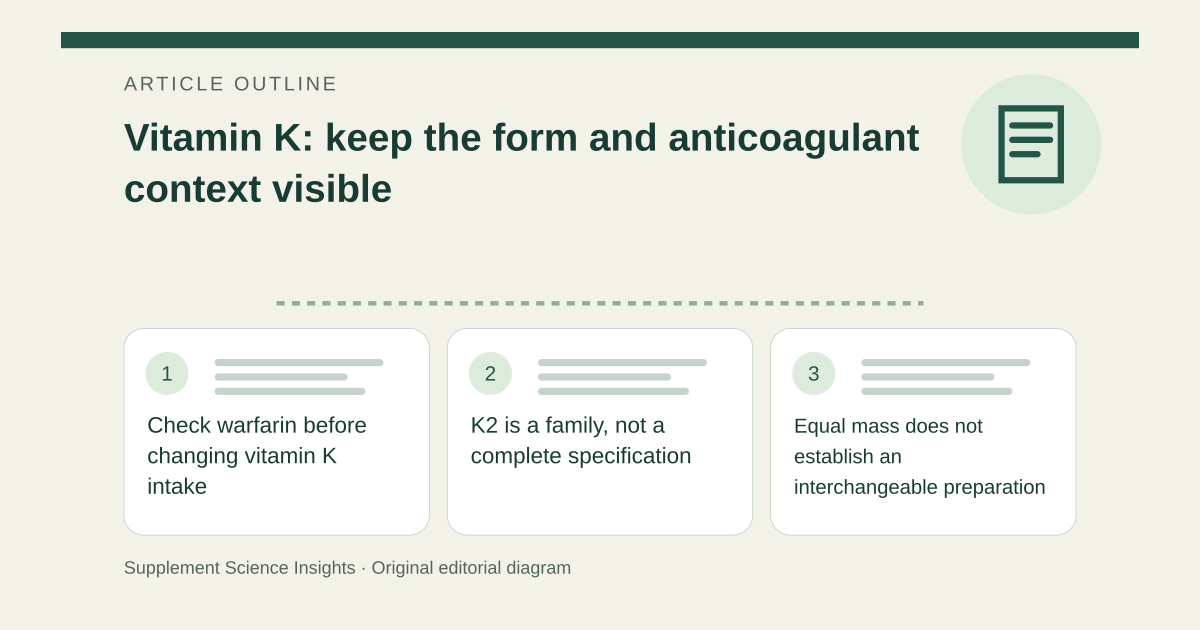
Check warfarin before changing vitamin K intake
Vitamin K can have a serious interaction with warfarin and related vitamin K antagonist anticoagulants. NIH ODS advises consistent intake from food and supplements because sudden changes can alter the anticoagulant effect. Discuss a proposed change with the clinician managing that treatment. [1]
This does not mean avoiding all vitamin K foods or adjusting an anticoagulant dose yourself. Bring the exact supplement label and a description of any intended dietary change. Keep a treatment decision separate from a product comparison. [1]
K2 is a family, not a complete specification
Vitamin K includes phylloquinone, or K1, and menaquinones, often grouped as K2. Supplements can contain forms such as MK-4 or MK-7. Record the specific form when it is disclosed rather than replacing it with the broader K2 label. [1]
A product combining vitamin D and vitamin K still has separate ingredient entries. Copy both amounts with their units; the presence of one does not define the amount of the other. If the form is missing, leave that field unresolved. [1]
Equal mass does not establish an interchangeable preparation
Consider two invented labels, each declaring 50 micrograms vitamin K per serving. One names MK-4; the other names MK-7. Their declared mass matches, but their stated forms differ. The number alone cannot establish clinical equivalence.
The example gives neither a recommended intake nor a reason to switch between them. A careful comparison retains both facts: equal labeled amounts and different forms. It does not infer the appropriate product for someone taking an anticoagulant.
| Field | Label A | Label B |
|---|---|---|
| Declared vitamin K per serving | 50 micrograms | 50 micrograms |
| Named form | MK-4 | MK-7 |
| Clinical equivalence | Not established | Not established |
| Personal intake recommendation | Not supplied | Not supplied |
A biological role is not a measured treatment result
Vitamin K participates in proteins involved in clotting and bone metabolism. That role does not, by itself, show that adding a particular supplement prevents fractures or cardiovascular events. [1]
When reading a stronger claim, identify the actual outcome. A change in a laboratory marker is different from fewer fractures. Preserve the participants, preparation and follow-up period before deciding whether the cited study answers the advertised question. [1]
Make the proposed change easy to review
Keep a dated record of the complete product name, labeled form, amount per serving, serving units and other ingredients. Include any multivitamin that also contains vitamin K. Mark whether each entry describes a label or actual use.
For a medication review, state what would change from the existing routine. A list that mixes current and proposed products without labeling them can obscure the question the clinician needs to answer.
What this introductory page establishes
The worked example prevents a form name from disappearing during a numerical comparison. It does not establish a dose, an INR target, absorbed amount or a superior retail product.
The ODS fact sheet was updated in March 2021 and inspected for this article in September 2026. It supports the cited background facts; it is not a newly completed review of all vitamin K trials. Independent scientific and editorial acceptance remains pending.
Sources for this article
- NIH ODS — Vitamin K: Health Professional Fact Sheet
Source consulted: 2026-09-17. This is a reference resource, not a claim that we conducted the studies or tested a product.