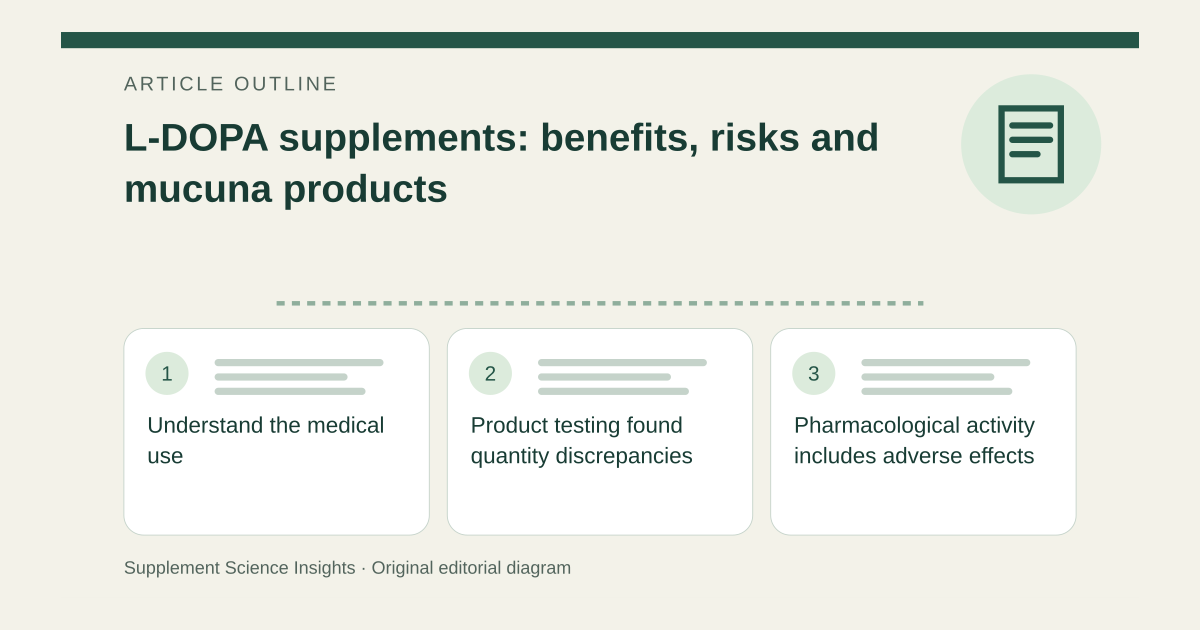
Understand the medical use
MedlinePlus explains that levodopa is converted to dopamine in the brain, while carbidopa reduces breakdown before it gets there. The combination treats Parkinson’s symptoms under a prescribed regimen. A capsule without the same formulation cannot be substituted milligram for milligram on the assumption that both are natural dopamine support. [1]
Product testing found quantity discrepancies
A 2025 laboratory study purchased four online botanical L-DOPA products and compared labels with chemical measurements using mass spectrometry and NMR. All contained L-DOPA, but some measured amounts differed from the labels. This small selected sample cannot estimate the quality of every brand or prove clinical benefit. [2]
Pharmacological activity includes adverse effects
Levodopa treatment can cause nausea, postural dizziness, sudden sleep episodes, hallucinations or impulse-control problems. A supplement containing the same active precursor deserves medicine-level review, especially alongside Parkinson’s drugs or psychiatric medicines. Do not abruptly replace prescribed therapy with mucuna. [1][3]
Review the evidence behind a brain-support claim
Imagine a product lists plant-extract milligrams but leaves actual L-DOPA unclear. Ask for the active amount and clinician review rather than treating the plant name as reassurance. The analytical study was publicly funded by the Italian medicines agency and reported no commercial conflicts; it measured products, not patient outcomes. [2]
| Claim or situation | Interpretation |
|---|---|
| Plant extract amount | Not necessarily L-DOPA amount |
| Prescription benefit | Specific formulation and indication |
| Four-product study | Quality signal, not a market census |
| Mood-boosting claim | Not established by dopamine chemistry |
Sources for this article
- Levodopa and Carbidopa: MedlinePlus Drug Information
Source consulted: 2026-09-21. This is a reference resource, not a claim that we conducted the studies or tested a product. - Quality assessment of “naturally occurring” high-percentage L-dopa commercial products proposed as dietary supplements on the Internet: from labeling to analytical findings - PMC
Source consulted: 2026-09-21. This is a reference resource, not a claim that we conducted the studies or tested a product. - Dietary Supplements: What You Need to Know - Consumer
Source consulted: 2026-09-21. This is a reference resource, not a claim that we conducted the studies or tested a product.