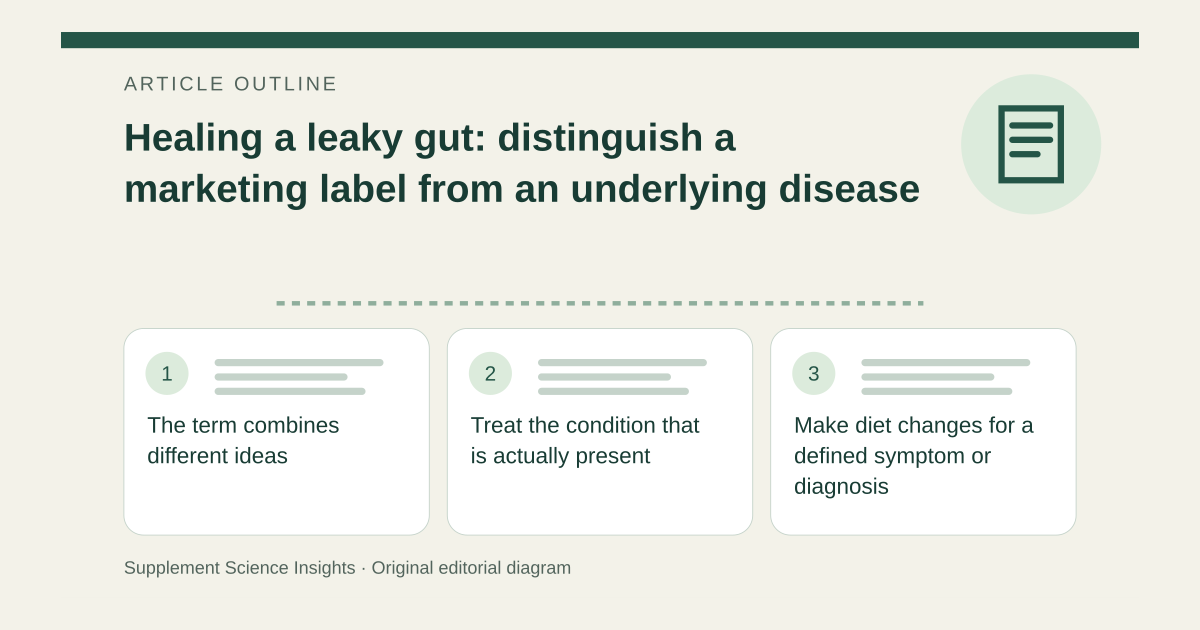
The term combines different ideas
Cleveland Clinic distinguishes measurable intestinal-barrier changes associated with disease from the hypothetical syndrome marketed for many nonspecific complaints. Bloating, fatigue or food discomfort alone does not establish a permeability disorder. A product’s diagnosis should not replace clinical assessment. [1]
Treat the condition that is actually present
The clinic emphasizes treatment of underlying problems such as celiac disease or inflammatory bowel disease. A supplement aimed at the lining cannot be assumed to control those conditions. Because causes and severity differ, a promise to repair every gut in a fixed number of days is not justified. [1]
Make diet changes for a defined symptom or diagnosis
A varied, adequate diet is preferable to an unexplained list of forbidden foods. For diagnosed IBS, a clinician may suggest a temporary low-FODMAP trial followed by reintroduction. That approach tests symptom tolerance; it does not prove that every excluded food was damaging the intestinal wall. [2]
Probiotics are not a universal repair kit
Probiotic findings depend on the organisms, preparation, population and outcome. A large CFU count does not demonstrate correction of an intestinal-barrier problem. Ask whether the evidence matches the diagnosed condition before paying for a multi-product gut-repair bundle. [3]
Track the real problem rather than the slogan
Imagine a restrictive diet and several powders are proposed for persistent diarrhea. Seek assessment for the cause and nutritional consequences, then agree what improvement and follow-up mean. Symptom relief, adequate nutrition and disease control are distinct outcomes. [4][1]
| Claim or situation | Useful next question |
|---|---|
| Vague gut-repair promise | Clarify the diagnosis and outcome |
| IBS food trial | Plan reintroduction and nutritional adequacy |
| Persistent diarrhea | Assess causes and possible malabsorption |
Sources for this article
- Leaky Gut Syndrome: Symptoms, Diet, Tests & Treatment
Source consulted: 2026-09-20. This is a reference resource, not a claim that we conducted the studies or tested a product. - Eating, Diet, & Nutrition for Irritable Bowel Syndrome - NIDDK
Source consulted: 2026-09-20. This is a reference resource, not a claim that we conducted the studies or tested a product. - Probiotics - Health Professional Fact Sheet
Source consulted: 2026-09-20. This is a reference resource, not a claim that we conducted the studies or tested a product. - Malabsorption (Syndrome): Symptoms, Causes & Treatment
Source consulted: 2026-09-20. This is a reference resource, not a claim that we conducted the studies or tested a product.