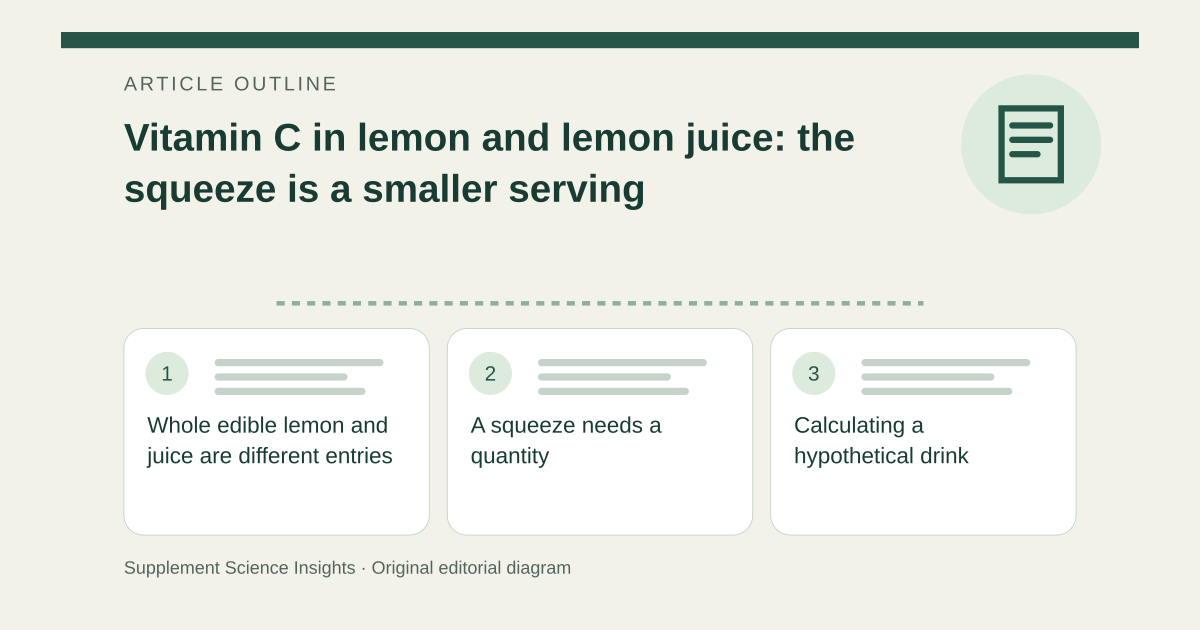
Whole edible lemon and juice are different entries
USDA SR Legacy 2018 lists raw lemon without peel at 53.0 mg vitamin C per 100 g and raw lemon juice at 38.7 mg per 100 g. The listed 58 g edible lemon provides about 30.7 mg. Lemon therefore contributes vitamin C, but a little juice should not be counted as that entire edible fruit. [1]
A squeeze needs a quantity
The raw-juice record gives 48 g as one lemon’s reference juice yield, which calculates to 18.6 mg vitamin C. Its 30.5 g fluid-ounce portion gives 11.8 mg. Actual yields vary. Bottled, heated or fortified juice needs a matching record or label rather than an automatic copy of this raw-juice estimate. [1][2]
Vitamin C supports normal collagen synthesis and has antioxidant functions, according to NIH ODS. Lemon can contribute to that nutrient intake. Those established vitamin functions do not prove that a particular lemon drink treats a disease or has benefits beyond an otherwise adequate diet. [1][2]
Calculating a hypothetical drink
Suppose a drink contains 15 g of raw lemon juice. The estimate is 5.8 mg vitamin C; using 30 g gives 11.6 mg. Adding plain water changes the drink’s concentration, not the amount supplied by the measured juice. These serving estimates do not establish special effects of lemon water. [1]
| Raw lemon juice used | Estimated vitamin C |
|---|---|
| 15 g | 5.8 mg |
| 30 g | 11.6 mg |
Sources for this article
- USDA FoodData Central — SR Legacy April 2018 food composition dataset
Source consulted: 2026-09-20. This is a reference resource, not a claim that we conducted the studies or tested a product. - Vitamin C - Health Professional Fact Sheet
Source consulted: 2026-09-20. This is a reference resource, not a claim that we conducted the studies or tested a product.