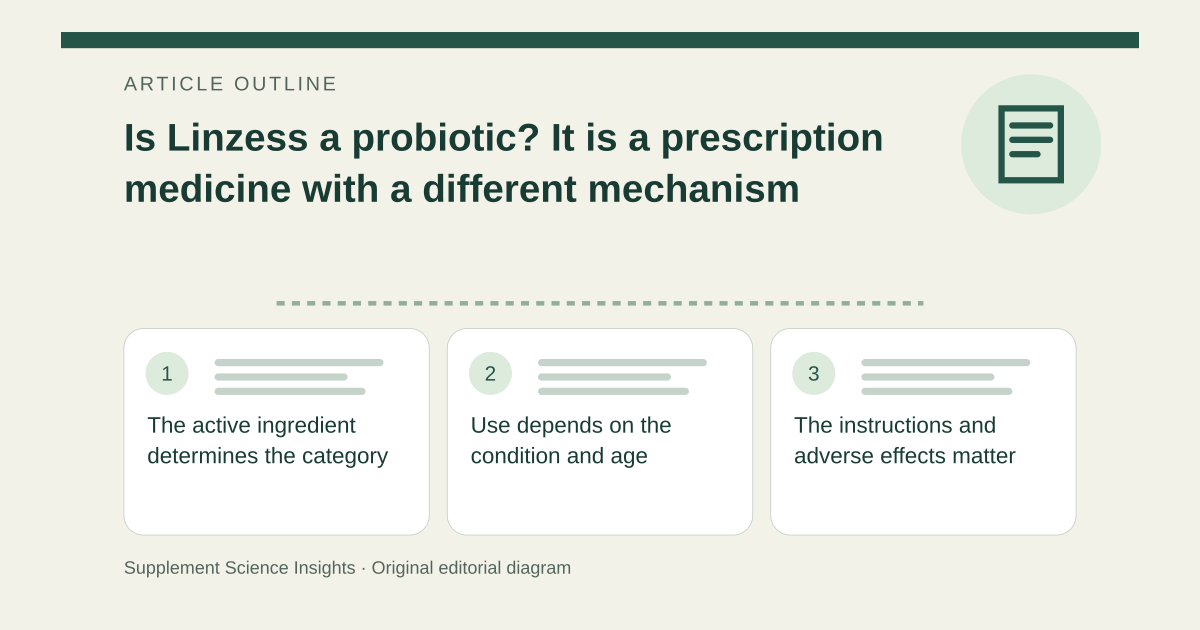
The active ingredient determines the category
The prescribing information identifies linaclotide as a guanylate cyclase-C agonist. Acting locally at the intestinal lining, it increases signaling that promotes chloride and bicarbonate secretion, fluid entry and transit. Probiotics, by contrast, are live microorganisms used for a demonstrated health benefit. [1][2]
Use depends on the condition and age
Linzess has labeled uses for specified constipation conditions, including adult IBS with constipation and chronic idiopathic constipation. Pediatric use is age- and indication-specific. It is contraindicated below age two and with known or suspected mechanical bowel obstruction. Do not share a prescription across age groups or diagnoses. [1]
The instructions and adverse effects matter
The label directs use on an empty stomach at least 30 minutes before a meal, at about the same time each day. Severe diarrhea requires suspending treatment and contacting the clinician for advice and rehydration. Do not dismiss it as proof that beneficial bacteria are working. [1]
Compare purposes rather than capsule appearance
Imagine someone wants to replace prescribed Linzess with a probiotic because both come in capsules. The active ingredients and mechanisms differ. Discuss the constipation plan and any adverse effects with the prescriber rather than assuming the products are equivalents. [1][2]
| Label or question | Meaning |
|---|---|
| Linaclotide | Prescription intestinal-signaling medicine |
| Live probiotic organisms | Different product category and evidence |
| Severe diarrhea | Suspend dosing and obtain clinical advice |
Sources for this article
- DailyMed - LINZESS- linaclotide capsule, gelatin coated
Source consulted: 2026-09-20. This is a reference resource, not a claim that we conducted the studies or tested a product. - Probiotics - Health Professional Fact Sheet
Source consulted: 2026-09-20. This is a reference resource, not a claim that we conducted the studies or tested a product.