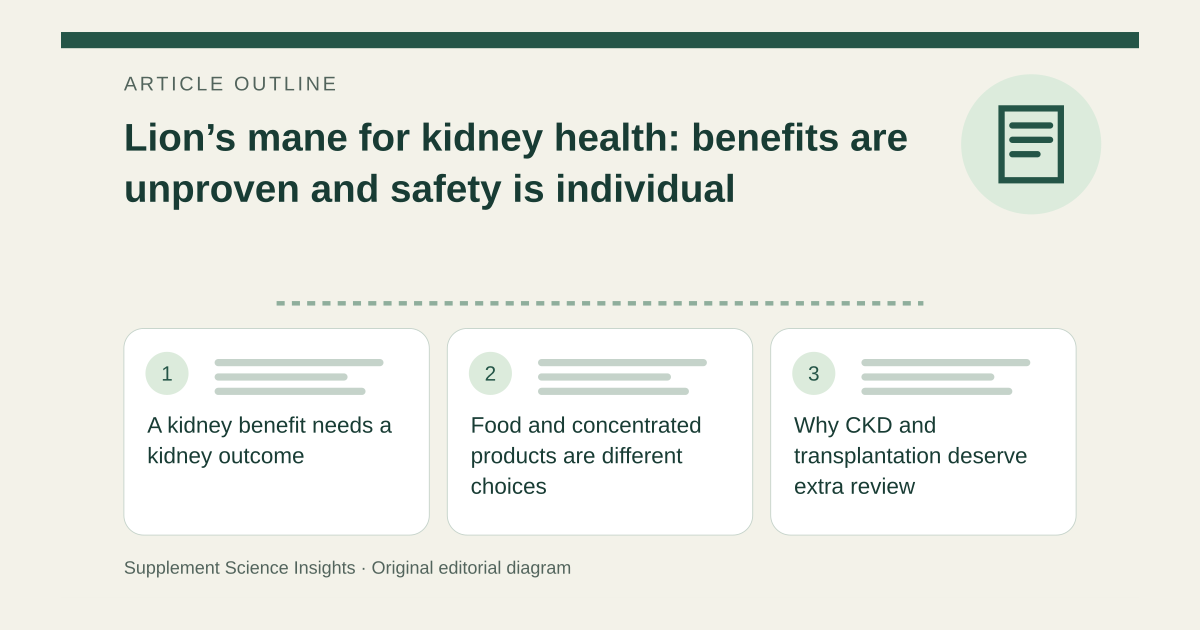
A kidney benefit needs a kidney outcome
MSK’s lion’s mane summary discusses mainly preclinical effects and limited cognition or mood research. It does not establish slower kidney-disease progression, improved filtration or prevention of kidney failure. Those are different outcomes from antioxidant activity in a laboratory. [1]
Food and concentrated products are different choices
A food-grade culinary mushroom in an individualized meal plan is not equivalent to a capsule or concentrated extract. OPSS notes variation in mushroom preparations, while NKF emphasizes that supplement ingredients, contamination and interactions matter in kidney disease. [2][3]
Why CKD and transplantation deserve extra review
NKF warns that kidney disease can increase risks from herbal products and that interactions with transplant medicines can have serious consequences. That general caution is not proof that lion’s mane itself causes kidney damage; it is a reason not to assume safety from limited studies in other populations. [3]
Avoid the kidney-cleanse shortcut
A promise to cleanse or restore kidneys does not establish a clinical benefit. Bring the complete label, dose and reason for use to the kidney team, including any other mushrooms or herbs in a blend. Continue prescribed monitoring and treatment while the product is reviewed. [3]
Match the claim to the clinical goal
Imagine someone with CKD sees a nerve-health advertisement and assumes it will protect kidney function too. The evidence does not make that connection. Reviewing the product with the renal pharmacist and following the established kidney plan is more useful than choosing a stronger extract. [3][1]
| Claim | Required distinction |
|---|---|
| Antioxidant activity | Not a kidney-function outcome |
| Edible mushroom | Not extract safety in CKD |
| Immune-support blend | Transplant medication review |
Sources for this article
- Lion's Mane Mushroom | Memorial Sloan Kettering Cancer Center
Source consulted: 2026-09-21. This is a reference resource, not a claim that we conducted the studies or tested a product. - Mushroom Dietary Supplements
Source consulted: 2026-09-21. This is a reference resource, not a claim that we conducted the studies or tested a product. - “Kidney Detox” and Herbal Supplements: What’s Safe and What’s Not | National Kidney Foundation
Source consulted: 2026-09-21. This is a reference resource, not a claim that we conducted the studies or tested a product.