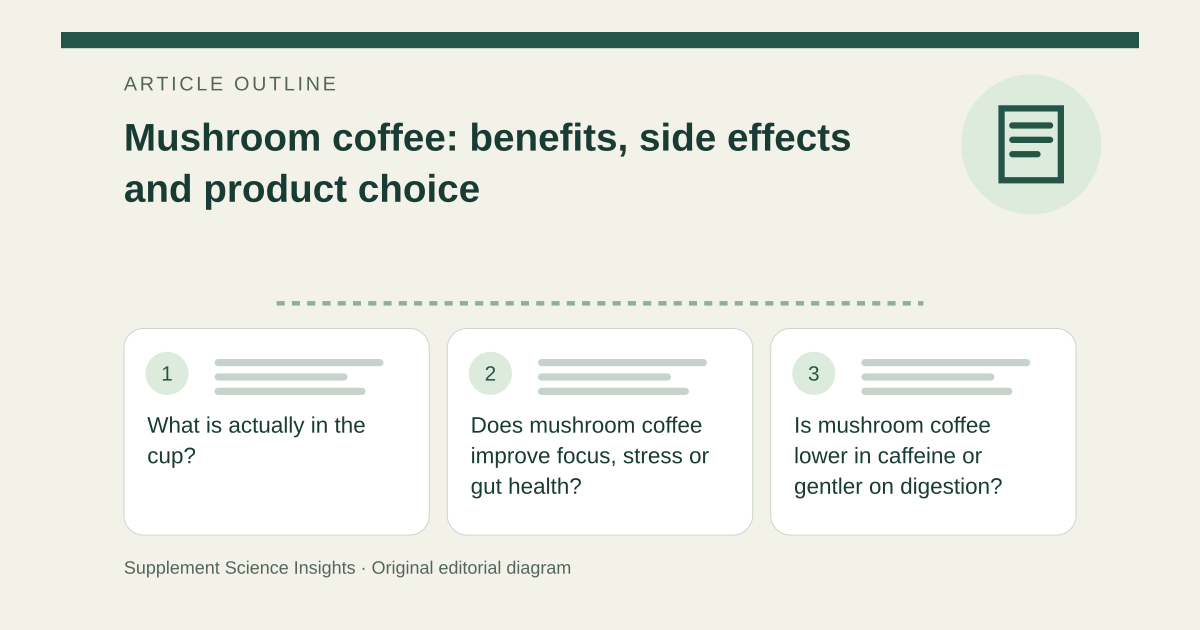
What is actually in the cup?
Cleveland Clinic describes mushroom coffee as coffee blended with processed mushroom ingredients, available in several formats. Products may differ substantially. A mushroom name alone does not tell you the caffeine level, extract amount, fiber content or nutrition of the prepared serving. [1]
Does mushroom coffee improve focus, stress or gut health?
An ingredient trial is not a trial of the finished cup. A study of a specified lion’s mane extract cannot establish the effect of a coffee containing an undisclosed mushroom blend. Harvard and Cleveland Clinic both emphasize the limited evidence for mushroom coffee itself. [8][1]
To assess a claim, match the mushroom species, part, preparation, daily quantity, other ingredients and measured outcome. If the beverage does not disclose enough information to do that, the clinical match remains unknown. A pleasant taste, a lower caffeine amount or a convenient ritual can be reasons to enjoy a drink without calling it a proven treatment. [8][1]
Is mushroom coffee lower in caffeine or gentler on digestion?
Check the caffeine declared for the exact prepared serving. Mushroom coffee can still contain coffee, and serving sizes vary. A label from another roast, another country or an older formula is not a reliable substitute. Count all daily caffeine sources before concluding that a switch reduces exposure. [3][2]
Added inulin, other fibers, sweeteners or creamers can change the digestive experience. Symptoms are not proof of detoxification. Distinguish caffeine sensitivity, a specific ingredient intolerance and a new medical problem rather than treating every reaction as an expected adjustment phase. [3][2]
What should a mushroom-coffee label and test report show?
Look for the species, ingredient or extract amounts, serving size, caffeine information, allergens and additional ingredients. Fruiting body, mycelium, extract ratio and beta-glucan statements describe different features; none alone proves a superior finished drink. A blend total does not reveal each mushroom’s amount. [2]
A useful certificate identifies the tested product and batch, laboratory, test methods and results for the claimed constituents and contaminants. A generic “third-party tested” statement without a matching report leaves those details unknown. Testing verifies selected quality measures; it does not supply missing clinical evidence. [2]
Pods, instant mixes or ground coffee: compare the prepared cup
Compare the cost of the actual serving, including the number of servings used per cup and any required additions. A subscription discount should be assessed with its recurring price and cancellation terms. Do not infer current value from a historical price or assume two blends contain equivalent mushroom quantities.
For pods, verify compatibility with the exact brewing system from the product and machine instructions. For disposal claims, check the material and local collection rules. Brewing compatibility, taste and recyclability can determine whether a format suits a household, but they do not establish a health advantage.
Benefits are not established by combining two ingredients
Claims about focus, immunity, stress or sleep often rely on research about individual ingredients rather than the finished drink. Cleveland Clinic highlights the limited evidence for mushroom coffee itself. OPSS likewise warns against assuming supplement processing preserves the same effects as whole mushrooms. [1][2]
Caffeine can still cause symptoms
FDA lists jitteriness, anxiety, sleep disruption, palpitations, nausea and stomach upset among possible effects of excess caffeine. Individual sensitivity varies, and total intake includes other drinks and products. Mushroom coffee is not automatically low-caffeine or caffeine-free. [3]
RYZE side effects depend on the version
The inspected RYZE Dark Roast page lists instant coffee, six mushrooms and an acacia/inulin/tapioca fiber blend; its FAQ gives approximately 80–90 mg caffeine per cup. This manufacturer information identifies that formula, not a clinical adverse-event study. Use the current package for your version instead of applying a different RYZE formula’s caffeine number or ingredients. [4]
Do not reinterpret discomfort as proof of benefit
Digestive upset or an allergic reaction can occur with mushroom products, and caffeine can contribute its own symptoms. The inspected evidence does not establish a predictable RYZE side-effect rate or prove that discomfort is a beneficial detox phase. Stop and review a product that causes concerning symptoms rather than pushing through them because of marketing claims. [2][3]
Medicines and kidney disease require a closer look
Mushroom blends may include reishi, which has bleeding and immune-treatment cautions. People with kidney disease should review supplements with their care team. The safety question concerns the whole formula and medical context, not simply whether it is sold as coffee. [5][6]
Compare your actual daily routine
Imagine replacing one small coffee with two larger servings of a mushroom blend plus creamer. Compare caffeine, serving size and additions before concluding that the change reduced stimulant exposure or improved nutrition. Taste preference is a reasonable beverage choice; it is separate from a proven health treatment. [3][7][1]
| Item | Check |
|---|---|
| Caffeine | Specific formula and all daily servings |
| Mushrooms | Species and preparation |
| New symptoms | Potential adverse effect, not assumed detox |
| Creamer and sweetener | Prepared-drink nutrition |
What is a useful alternative to VitaCup mushroom coffee?
Choose the feature you want to match first. Four Sigmatic Focus Coffee Pods are a comparison candidate when the priority is a coffee pod containing lion’s mane. On the manufacturer pages inspected October 28, 2026, VitaCup described lion’s mane and chaga powders plus B and D vitamins and approximately 110 mg caffeine per serving; Four Sigmatic described coffee, lion’s mane extract and yacon, with approximately 72–88 mg caffeine per pod. [9][10]
Those are manufacturer formulation statements, not independent assays or evidence that the drinks produce equal effects. The products do not match every ingredient or caffeine amount, and the pages do not establish identical taste. A closest match for brewer format may not be the closest match for vitamins, mushroom preparation or caffeine. Compare the exact current package before choosing; no universal or market-wide winner follows from this example. [9][10]
Who might prefer pods, and what do we know about actual users?
A compatible pod can suit someone who values a quick, repeatable brewing routine. A powder can suit someone who wants to adjust the mixture or use a different preparation method. These are conditional practical examples, not measured claims about the typical buyer’s age, health, motivations or frequency of use.
The sources reviewed for this guide do not supply a representative demographic survey of mushroom-coffee-pod users. Marketing personas, customer reviews and our examples should not be presented as that kind of evidence. Decide whether the format fits your routine without assuming that the habits of an imagined typical user establish a health benefit.
Do the sources establish an expert consensus?
Harvard Health and Cleveland Clinic both discuss the limited evidence for mushroom coffee itself and the problem of transferring ingredient research to a finished drink. These are named clinical editorial sources. They do not constitute a formal survey or consensus panel representing every expert. [8][1]
Keep the evidence type visible: a human trial supports findings about its tested preparation, a clinical reference interprets an evidence base, and a maker describes its own product. Apparent disagreement may concern different species, extracts, amounts or outcomes. None of those sources should be converted into an invented expert endorsement of a brand or brewing recipe. [8][1]
Whose brewing instructions should you follow?
Use the directions for the exact product and brewer. For example, Four Sigmatic’s inspected Focus-pod page says the pods can be brewed hot or over ice in compatible Keurig K-Cup systems, including 2.0. That is a manufacturer instruction for that product, not an independent barista recommendation or a method for every mushroom powder. [10]
Adjustments to water volume, temperature within the machine’s instructions, or added milk can be personal taste experiments. Label them that way rather than calling them expert consensus. A three-person editorial tasting exercise would also describe only that panel and method; it cannot establish population preference or a clinical dose delivered in every cup. [10]
Sources for this article
- Mushroom Coffee: What It Is and Benefits
Source consulted: 2026-09-21. This is a reference resource, not a claim that we conducted the studies or tested a product. - Mushroom Dietary Supplements
Source consulted: 2026-09-21. This is a reference resource, not a claim that we conducted the studies or tested a product. - Spilling the Beans: How Much Caffeine is Too Much? | FDA
Source consulted: 2026-09-21. This is a reference resource, not a claim that we conducted the studies or tested a product. - Mushroom Coffee Dark Roast Starter Kit (60 servings) – RYZE
Source consulted: 2026-09-21. This is a reference resource, not a claim that we conducted the studies or tested a product. - Reishi Mushroom | Memorial Sloan Kettering Cancer Center
Source consulted: 2026-09-21. This is a reference resource, not a claim that we conducted the studies or tested a product. - “Kidney Detox” and Herbal Supplements: What’s Safe and What’s Not | National Kidney Foundation
Source consulted: 2026-09-21. This is a reference resource, not a claim that we conducted the studies or tested a product. - How to Understand and Use the Nutrition Facts Label | FDA
Source consulted: 2026-09-21. This is a reference resource, not a claim that we conducted the studies or tested a product. - Harvard Health — Mushroom coffee: Worth a taste?
Source consulted: 2026-10-28. This is a reference resource, not a claim that we conducted the studies or tested a product. - VitaCup — Mushroom Coffee Pods (Focus product URL)
Source consulted: 2026-10-28. This is a reference resource, not a claim that we conducted the studies or tested a product. - Four Sigmatic — Focus Coffee Pods, 24 count
Source consulted: 2026-10-28. This is a reference resource, not a claim that we conducted the studies or tested a product.