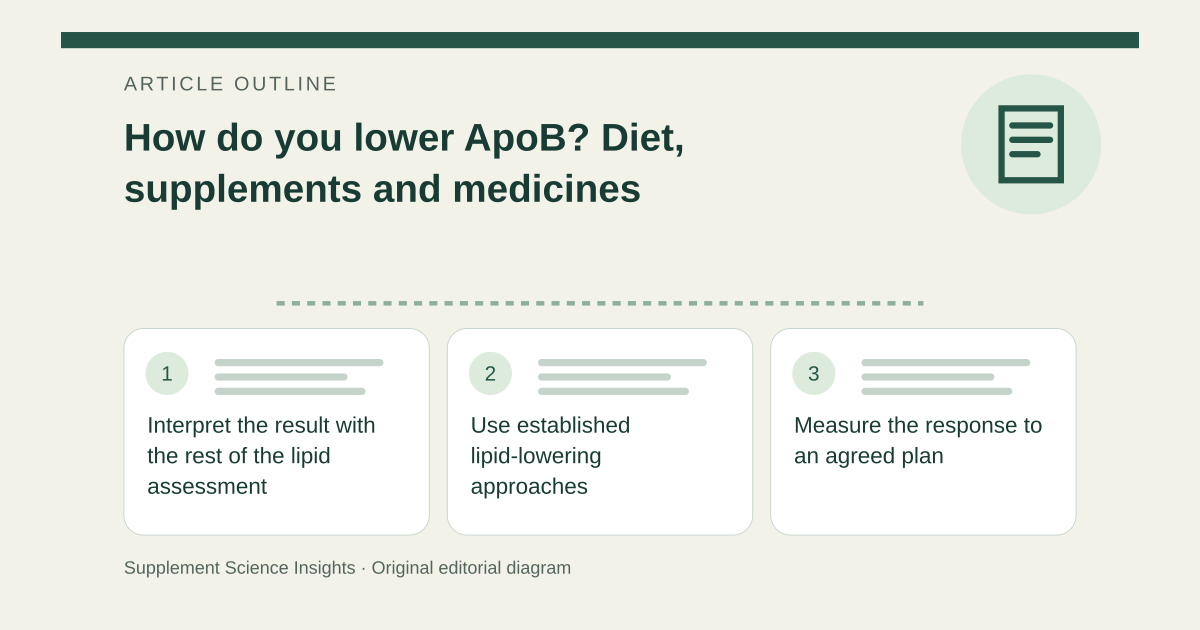
Interpret the result with the rest of the lipid assessment
The National Lipid Association supports ApoB as a useful risk measure, particularly when it disagrees with LDL cholesterol. Its consensus notes that treatment thresholds are less established than those for LDL-C and should be interpreted by risk category. A single number therefore should not become a self-prescribed treatment plan. [1]
Use established lipid-lowering approaches
Dietary changes and appropriate activity form part of management, while medicines may be needed when risk or lipid burden warrants them. NHS guidance describes healthier eating, more exercise and using cholesterol medicine when needed. A supplement’s LDL claim cannot be assumed to deliver the necessary ApoB reduction or clinical benefit. [2][1]
Measure the response to an agreed plan
Imagine LDL-C looks acceptable but ApoB remains elevated. Discuss that discordance and overall risk with the clinician rather than simply buying a second cholesterol supplement. Agree on the intervention and repeat testing. Do not stop an effective prescribed medicine in favor of a product whose outcome evidence does not match the goal. [1][3]
| Situation | Appropriate distinction |
|---|---|
| A symptom | Identify its cause |
| A marketing promise | Check the measured outcome |
| A treatment change | Review suitability and follow-up |
Sources for this article
- Role of ApoB in Clinical Management of Cardiovascular Risk in Adults — NLA
Source consulted: 2026-09-21. This is a reference resource, not a claim that we conducted the studies or tested a product. - High cholesterol - NHS
Source consulted: 2026-09-21. This is a reference resource, not a claim that we conducted the studies or tested a product. - Dietary Supplements: What You Need to Know - Consumer
Source consulted: 2026-09-21. This is a reference resource, not a claim that we conducted the studies or tested a product.