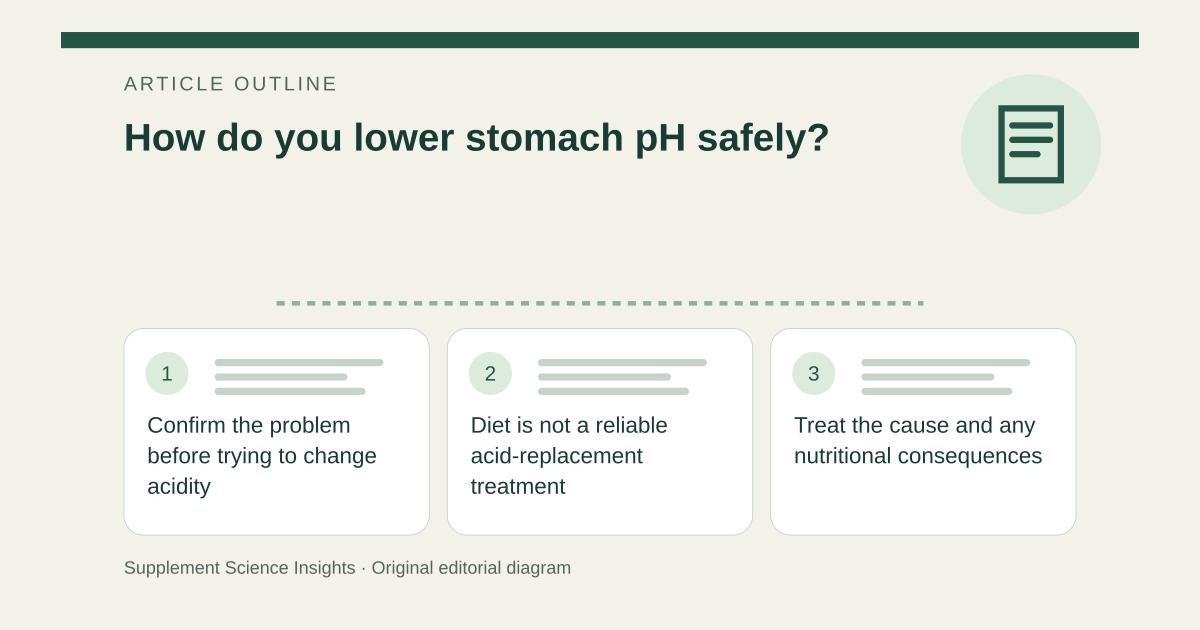
Confirm the problem before trying to change acidity
Cleveland Clinic describes hypochlorhydria as inadequate stomach acid and outlines clinical testing and evaluation of underlying causes. Bloating or indigestion alone does not establish the diagnosis. A home symptom experiment cannot determine whether acid production, another digestive condition or a medicine is responsible. [1]
Diet is not a reliable acid-replacement treatment
The clinical overview states that diet alone will not restore stomach acid. It describes betaine hydrochloride as an option in selected circumstances with professional guidance, not something suitable for everyone. Do not stop an acid-suppressing medicine or escalate acid capsules without discussing why the medicine was prescribed. [1]
Treat the cause and any nutritional consequences
Imagine persistent fullness leads someone to try vinegar and acid tablets. The more useful next step is evaluation, including whether infection, inflammation or nutrient deficiencies are involved. A treatment plan may address these separately. The goal is effective digestion and symptom resolution, not achieving an arbitrary pH at home. [1]
| Question | Useful check |
|---|---|
| What is the target? | A defined symptom or clinical result |
| What is the exposure? | Full formula and medicines |
| What supports the claim? | Evidence matching the person and outcome |
Sources for this article
- Hypochlorhydria (Low Stomach Acid): Symptoms, Tests, Treatment
Source consulted: 2026-09-21. This is a reference resource, not a claim that we conducted the studies or tested a product.