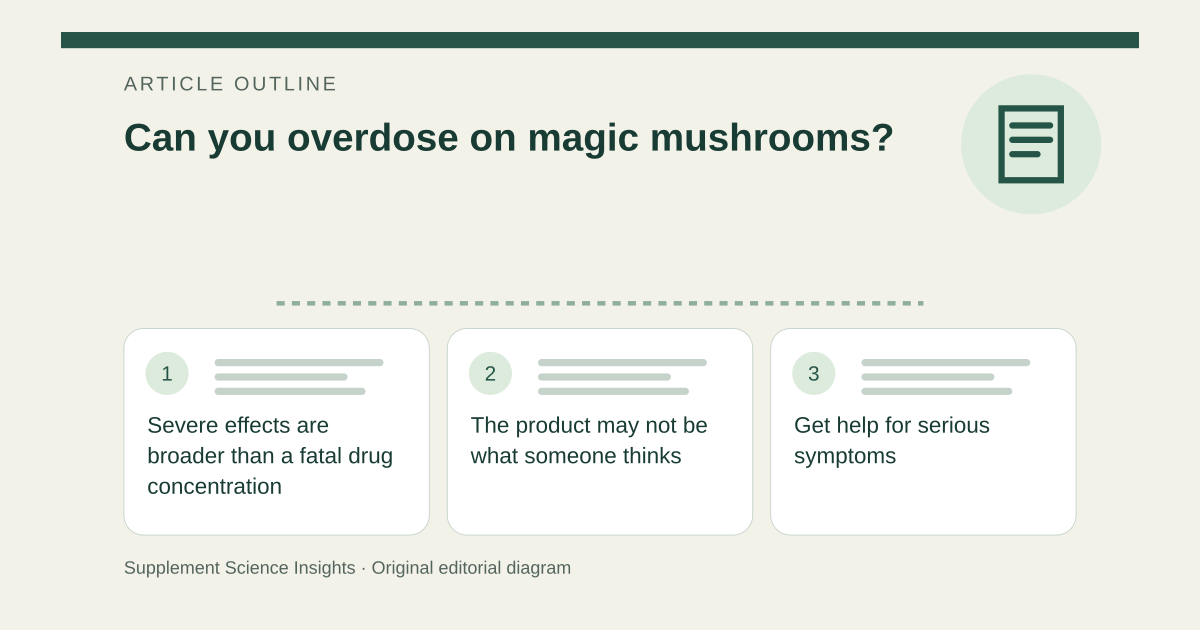
Severe effects are broader than a fatal drug concentration
Intense panic, confusion, vomiting, agitation and markedly increased heart rate can require medical care. Impaired judgment can also lead to falls, traffic injuries or other dangerous behavior. A person can need urgent treatment without a laboratory-confirmed overdose. [1]
The product may not be what someone thinks
Some toxic mushrooms resemble psychoactive species. These can damage the liver or kidneys, and cooking or drying does not reliably neutralize their toxins. Unregulated products may also contain substances different from their labels. [2][1]
Get help for serious symptoms
Call emergency services for collapse, a seizure, difficulty breathing or immediate danger to the person or others. In the United States, Poison Control at 1-800-222-1222 can advise on an exposure; do not wait for symptoms if a poisonous species may have been swallowed. [2][3]
Do not let an uncertain amount delay assessment
Imagine someone becomes severely confused after one labeled gummy. One unit is not a verified dose or ingredient list. Stay nearby if safe, prevent access to hazards and give responders accurate information about the product and other substances. [1][2]
| Feature | Response |
|---|---|
| Seizure or collapse | Emergency services |
| Unknown wild species | Prompt poison-control advice |
| One labeled serving | Does not rule out severe poisoning |
| Initially mild symptoms | Not proof that all hazards have passed |
Sources for this article
- Psychedelic and Dissociative Drugs | National Institute on Drug Abuse (NIDA)
Source consulted: 2026-09-21. This is a reference resource, not a claim that we conducted the studies or tested a product. - Magic Mushrooms (Psilocybin) Safety | California Poison Control System
Source consulted: 2026-09-21. This is a reference resource, not a claim that we conducted the studies or tested a product. - What to do if someone has a seizure (fit) - NHS
Source consulted: 2026-09-21. This is a reference resource, not a claim that we conducted the studies or tested a product.