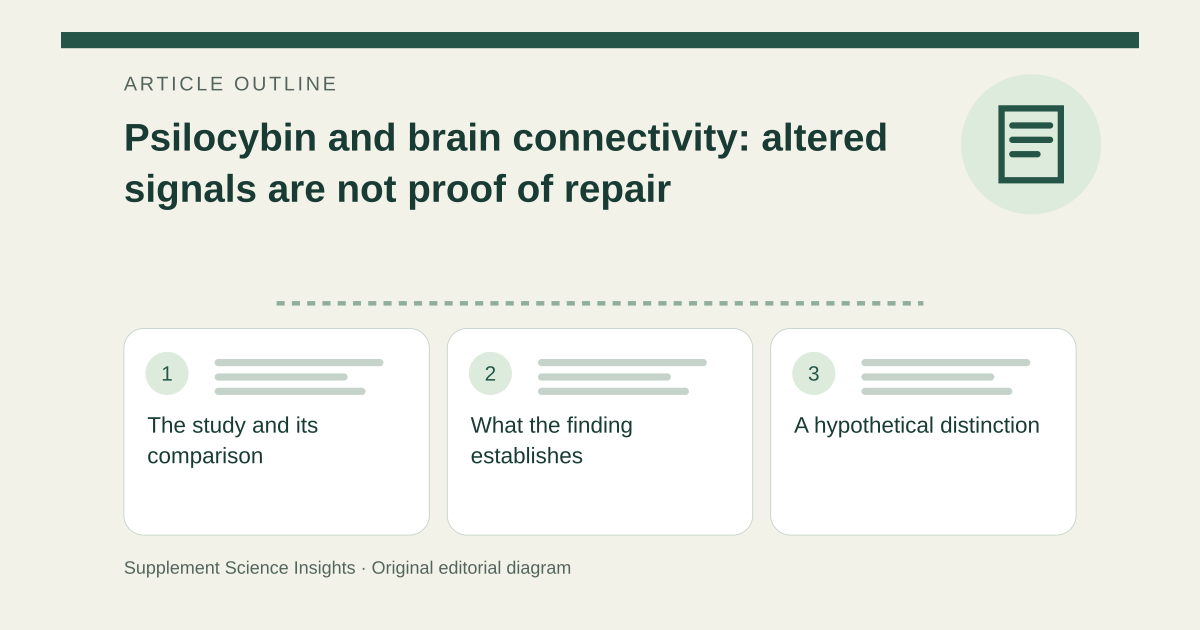
The study and its comparison
Healthy adults underwent repeated functional brain mapping before, during and after psilocybin and methylphenidate sessions. Investigators tracked network changes over weeks and returned for later follow-up. [1]
Psilocybin disrupted usual connectivity patterns, with prominent default-mode-network changes. Some hippocampal connectivity changes persisted, and performing a perceptual task reduced acute changes. [1]
What the finding establishes
Functional connectivity measures correlations in brain signals, not direct proof of new neurons or repaired tissue. Repeated scans do not equal many independent participants; sample size was not established from the retrieved abstract. Investigators disclosed mapping patents and professional relationships. These observations do not demonstrate a treatment benefit by themselves. [1]
A hypothetical distinction
Imagine many scans come from each volunteer. Counting scans as independent people would overstate the evidence.
| Detail | Interpretation |
|---|---|
| Measured outcome | Keep the endpoint specific |
| Study preparation | Not every retail product |
| Remaining uncertainty | Not resolved by a mechanism |
Sources for this article
- Psilocybin desynchronizes the human brain.
Source consulted: 2026-09-19. This is a reference resource, not a claim that we conducted the studies or tested a product.