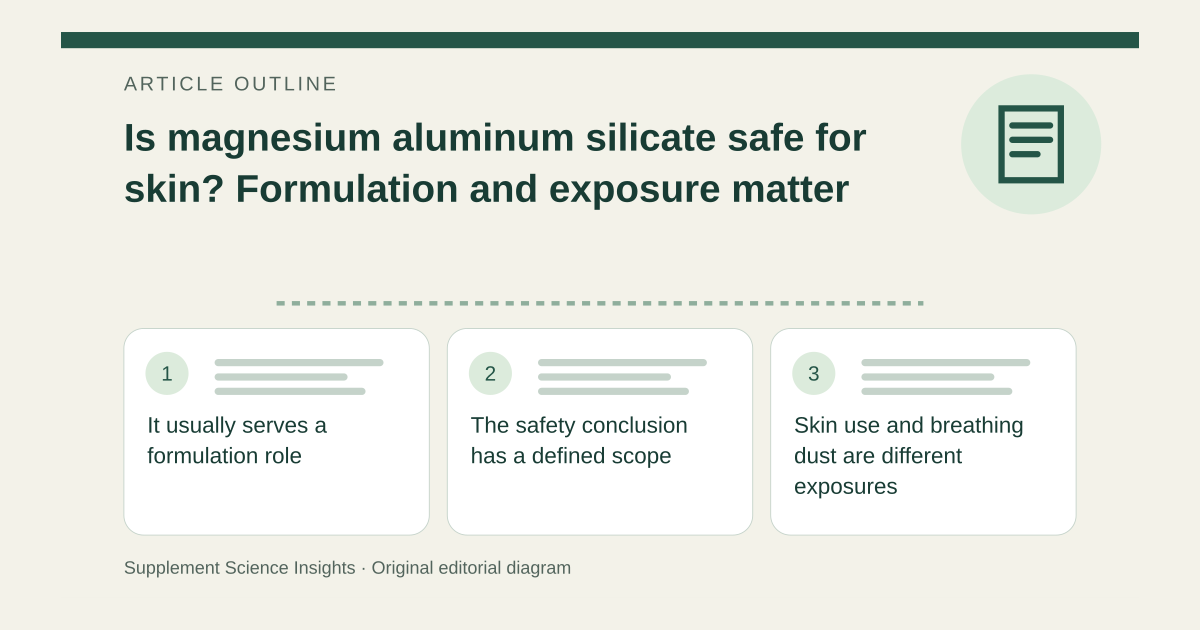
It usually serves a formulation role
The published assessment describes silicates used for functions such as thickening, stabilizing, suspending or changing the appearance of a cosmetic. An ingredient serving those roles is not necessarily included to deliver nutritional magnesium through the skin. [1]
The safety conclusion has a defined scope
The 2003 CIR report concluded that the evaluated ingredients were safe in the cosmetic uses described, while advising that sprays minimize inhalation of solids. Its assessment explicitly excluded talc because of its distinct structure. This summary should not be read as an assessment of every mineral powder or current finished product. [1]
Skin use and breathing dust are different exposures
A cream containing a dispersed ingredient is not the same exposure as handling or inhaling loose powder. Avoid converting a cosmetic safety conclusion into permission to aerosolize raw material. Follow the intended use of the actual product. [1]
The complete formula still determines suitability
Other ingredients, contamination, storage and personal irritation can affect how a product behaves. FDA places responsibility for cosmetic safety on the manufacturer; a familiar ingredient name does not independently validate the finished mixture. Stop using a product that causes a significant reaction and seek appropriate advice. [2][3]
Do not infer mineral nutrition from a cosmetic label
Imagine someone sees magnesium aluminum silicate in a moisturizer and assumes it corrects low magnesium. A thickening ingredient and a nutritional treatment are different uses. The evidence does not support using the moisturizer as a measured replacement dose. [4][5]
| Context | Relevant distinction |
|---|---|
| Formulated moisturizer | Covered cosmetic-use context may apply |
| Loose airborne powder | Different inhalation exposure |
| Talc comparison | Not included in the cited assessment |
| Magnesium in the ingredient name | Not a nutritional replacement claim |
Sources for this article
- Final report on the safety assessment of aluminum silicate, calcium silicate, magnesium aluminum silicate, magnesium silicate, magnesium trisilicate, sodium magnesium silicate, zirconium silicate, attapulgite, bentonite, Fuller's earth, hectorite, kaolin, lithium magnesium silicate, lithium magnesium sodium silicate, montmorillonite, pyrophyllite, and zeolite.
Source consulted: 2026-09-21. This is a reference resource, not a claim that we conducted the studies or tested a product. - Cosmetics Safety Q&A: Personal Care Products | FDA
Source consulted: 2026-09-21. This is a reference resource, not a claim that we conducted the studies or tested a product. - Microbiological Safety and Cosmetics | FDA
Source consulted: 2026-09-21. This is a reference resource, not a claim that we conducted the studies or tested a product. - Magnesium - Health Professional Fact Sheet
Source consulted: 2026-09-21. This is a reference resource, not a claim that we conducted the studies or tested a product. - Myth or Reality—Transdermal Magnesium? - PMC
Source consulted: 2026-09-21. This is a reference resource, not a claim that we conducted the studies or tested a product.