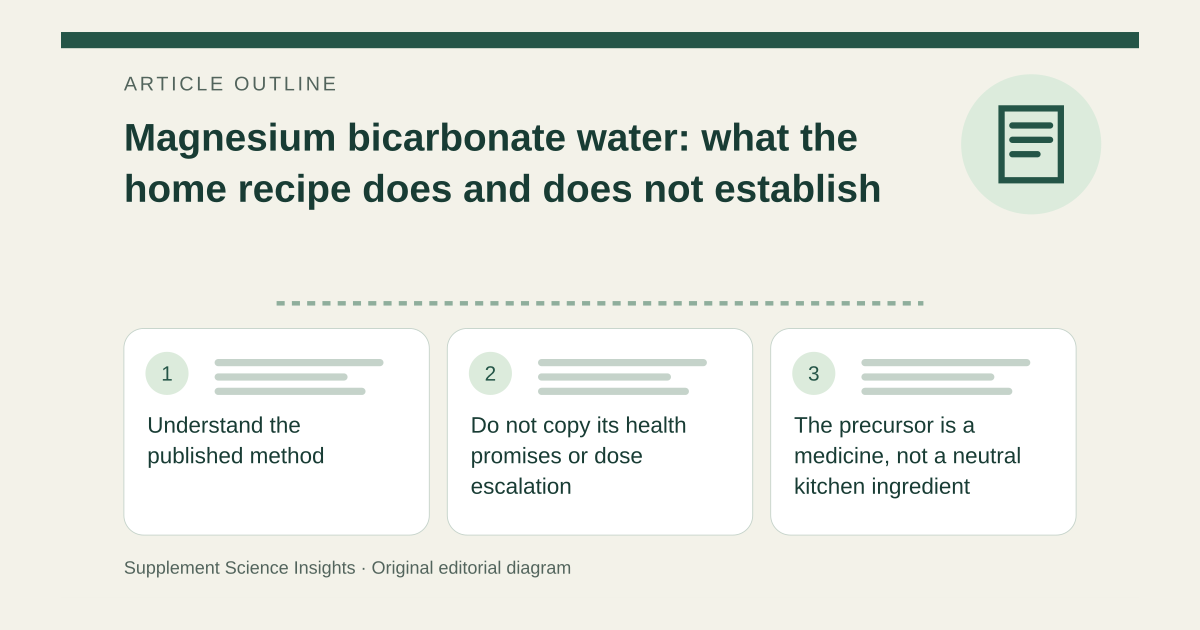
Understand the published method
The inspected 2020 Dr Davis recipe adds a measured milk-of-magnesia suspension slowly to carbonated water, closes and shakes the container, then waits for the cloudy mixture to clarify. It uses 45 mL of suspension with two liters of carbonated water. This is a description of that historical recipe, not verification of current products or an instruction to drink the whole batch. [1]
Do not copy its health promises or dose escalation
The recipe page makes strong absorption and treatment claims and suggests increasing intake. The inspected page does not present a comparative clinical trial validating those claims. Its reported concentration also depends on the starting preparation; it cannot be assumed for any bottle labeled milk of magnesia. [1]
The precursor is a medicine, not a neutral kitchen ingredient
MedlinePlus describes magnesium hydroxide as a laxative and antacid with medical precautions, including kidney disease and medicine use. Read the actual product strength and full ingredients. Do not improvise chemical processing to remove an ingredient or substitute an unrelated magnesium powder. [2]
Concentration and personal dose are separate
NIH distinguishes elemental magnesium from compound weight and sets an adult upper limit of 350 mg daily from supplements and medications unless a clinician recommends otherwise. This is not a target or a guarantee for kidney disease. Home appearance cannot confirm a concentration, and the recipe does not establish a tested shelf life. [3][1]
Use a known amount rather than guessing from volume
Imagine a verified preparation contained 100 mg elemental magnesium per 100 mL. A 50 mL portion would contain 50 mg, but that arithmetic is only useful when the starting concentration is actually known. For a replacement plan, a product with a clear elemental label is easier to assess than an unassayed homemade batch. [3]
| Measure | Hypothetical value |
|---|---|
| Verified concentration | 100 mg per 100 mL |
| Portion | 50 mL |
| Elemental amount | 50 mg |
| Unknown home concentration | Cannot use this example as its dose |
Sources for this article
- Magnesium Water: Step-by-Step - Dr. William Davis
Source consulted: 2026-09-21. This is a reference resource, not a claim that we conducted the studies or tested a product. - Magnesium Hydroxide: MedlinePlus Drug Information
Source consulted: 2026-09-21. This is a reference resource, not a claim that we conducted the studies or tested a product. - Magnesium - Health Professional Fact Sheet
Source consulted: 2026-09-21. This is a reference resource, not a claim that we conducted the studies or tested a product.