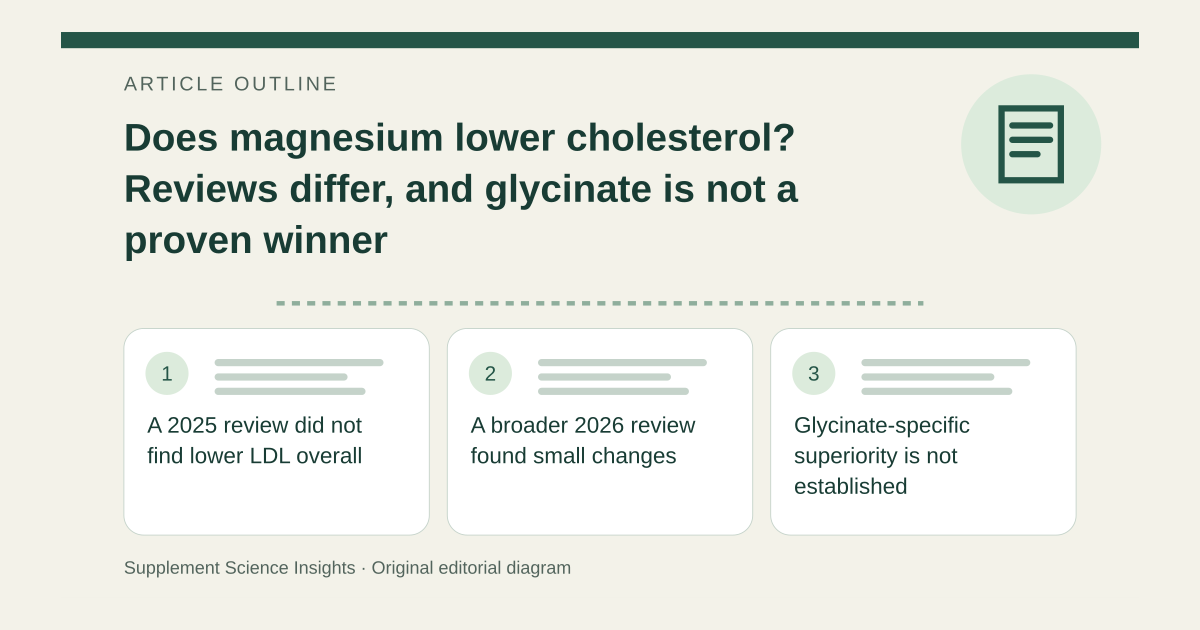
A 2025 review did not find lower LDL overall
The 2025 lipid meta-analysis found no significant pooled reductions in LDL, total cholesterol or triglycerides, although HDL rose slightly. Heterogeneity was very high, meaning the studies differed substantially. The authors called for more evidence before robust clinical recommendations. [1]
A broader 2026 review found small changes
The later review included 78 trials across cardiometabolic outcomes and reported modest LDL and triglyceride reductions and an HDL increase, with no significant total-cholesterol change. It also described uncertain clinical relevance and varying evidence certainty. The differing pooled findings do not justify a guaranteed response. [2]
Glycinate-specific superiority is not established
A pooled result across magnesium interventions cannot automatically be assigned to every glycinate product. The later review still identified uncertainty about the best formulation, dose and duration. Better tolerance or absorption is not proof of a larger cholesterol effect. [2][3]
A lipid change is not proof of fewer heart attacks
The reviews summarized risk-factor measurements. They do not establish that choosing magnesium instead of established cholesterol treatment prevents cardiovascular events. Keep diet, overall risk assessment and prescribed medicines in the treatment discussion. [2][4]
Use follow-up measurements rather than a label promise
Both reviews reported no conflicts; the later review reported no external study funding and disclosed public or institutional support for an author. Individual need, kidney function and medicine interactions still matter. Imagine LDL improves after a statin, diet changes and magnesium start together: the result cannot be assigned to magnesium alone. [1][2][3]
| Evidence | Limit |
|---|---|
| Small pooled LDL reduction | Not a guaranteed individual effect |
| Magnesium studies | Not proof of glycinate superiority |
| Lipid biomarker | Not the same as fewer cardiovascular events |
| Several treatments changed | Cannot isolate one contributor |
Sources for this article
- The effect of magnesium supplementation on serum concentration of lipid profile: an updated systematic review and dose-response meta-analysis on randomized controlled trials - PMC
Source consulted: 2026-09-21. This is a reference resource, not a claim that we conducted the studies or tested a product. - Comprehensive Effects of Magnesium Supplementation on Cardiometabolic Risk Factors: A Systematic Review and Dose–Response Meta-Analysis - PMC
Source consulted: 2026-09-21. This is a reference resource, not a claim that we conducted the studies or tested a product. - Magnesium - Health Professional Fact Sheet
Source consulted: 2026-09-21. This is a reference resource, not a claim that we conducted the studies or tested a product. - Cholesterol Management at a Glance | NCCIH
Source consulted: 2026-09-21. This is a reference resource, not a claim that we conducted the studies or tested a product.