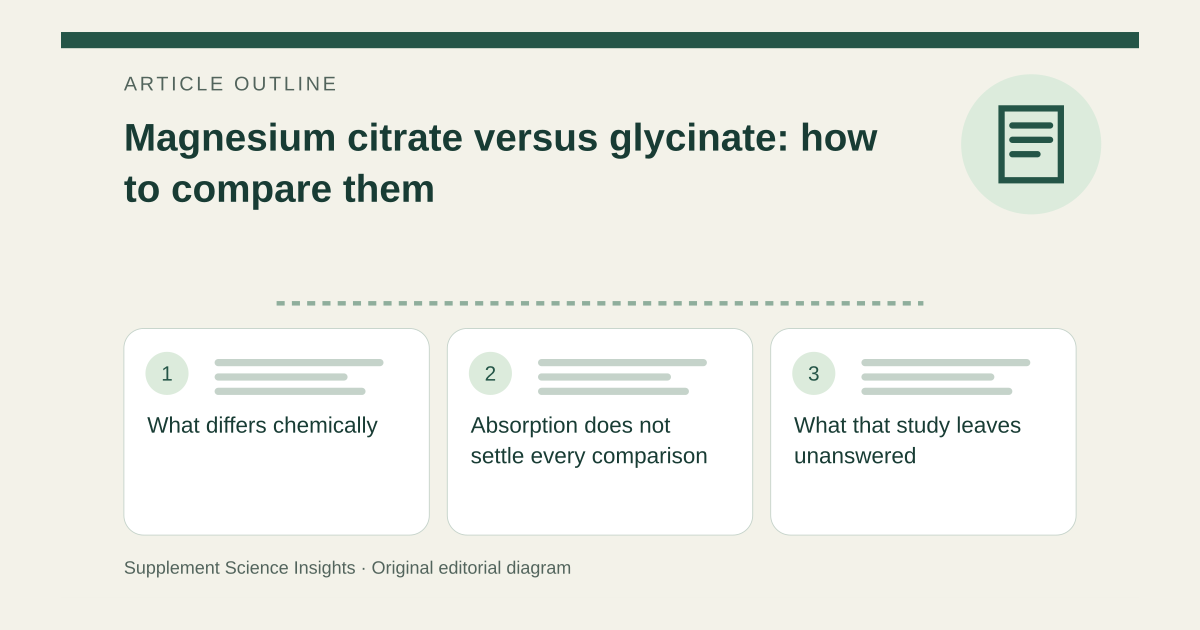
What differs chemically
Magnesium citrate pairs magnesium with citrate, while magnesium glycinate or bisglycinate describes a glycine-related magnesium preparation. Glycinate is the deprotonated form of the amino acid glycine. The compound names help identify the formulation; they do not directly state how much elemental magnesium a serving contains. [1][2]
NIH explains that the Supplement Facts magnesium amount is elemental magnesium, not the mass of the entire compound. Compare that amount first. Equal numbers for compound weight can represent unequal magnesium amounts, and mixtures marketed as buffered may contain more than one magnesium source. [1][2]
Absorption does not settle every comparison
NIH reports that more soluble forms such as citrate are generally absorbed better than poorly soluble forms such as oxide. That does not establish a universal citrate-versus-glycinate ranking or show which produces the better clinical outcome for sleep, cramps or another symptom. [1][3]
A 2018 single-day crossover study compared several preparations, including citrate and bisglycinate, using magnesium measurements in blood, urine and red cells. Its main reported advantages concerned a separate proprietary formulation. It did not establish that either citrate or glycinate is the best treatment for every person. [1][3]
What that study leaves unanswered
The inspected abstract reports healthy participants, repeated crossover exposures and one-week washouts, but does not provide the sample size or enough funding and conflict detail for a full appraisal. An author affiliation identifies a supplement manufacturer. These limits are important when interpreting a commercial-formulation comparison. [3]
The authors themselves called for studies to determine whether bioavailability differences translate into clinical efficacy. A laboratory or blood-marker advantage should not be relabeled as demonstrated relief of insomnia or anxiety. [3]
Bowel effects and the reason for use
Magnesium citrate is also sold as a saline laxative for short-term treatment of occasional constipation. That medicine's dose and directions are a separate matter from a nutritional supplement. Its water-retaining effect in the bowel helps explain why purpose and formulation matter. [4][1]
Magnesium supplements can cause diarrhea, nausea or cramps. Glycinate is often marketed as gentler, but the evidence inspected here does not justify promising that it never causes gastrointestinal effects or is always better tolerated. Individual response and the elemental amount remain relevant. [4][1]
A practical decision framework
Clarify whether the goal is nutrient supplementation, a clinician-directed treatment or short-term constipation relief. Then check the elemental amount, other ingredients, kidney health and medication interactions. Kidney impairment raises the risk of excess magnesium, and some medicines require attention to timing. [1][4]
A larger capsule or a higher price is not evidence of a better outcome. If supplementation is appropriate, the most useful comparison is between clearly identified products at relevant amounts, with attention to tolerability and the evidence for the actual goal. [1][4]
A hypothetical like-for-like comparison
Suppose citrate and glycinate products each declare 100 mg elemental magnesium per serving. Their nutrient amounts match in this example, even though their total compound weights differ. The next comparison is use and tolerability, not adding the compound weights to the declared magnesium amount. [1]
| Question | What to compare |
|---|---|
| How much magnesium? | Elemental magnesium per serving |
| Why use it? | Nutritional goal versus a laxative medicine |
| Which works better? | Relevant outcome evidence, not marketing alone |
Sources for this article
- Magnesium - Health Professional Fact Sheet
Source consulted: 2026-09-20. This is a reference resource, not a claim that we conducted the studies or tested a product. - glycinate (CHEBI:32508)
Source consulted: 2026-09-20. This is a reference resource, not a claim that we conducted the studies or tested a product. - Magnesium bioavailability after administration of sucrosomial® magnesium: results of an ex-vivo study and a comparative, double-blinded, cross-over study in healthy subjects.
Source consulted: 2026-09-20. This is a reference resource, not a claim that we conducted the studies or tested a product. - Magnesium Citrate: MedlinePlus Drug Information
Source consulted: 2026-09-20. This is a reference resource, not a claim that we conducted the studies or tested a product.