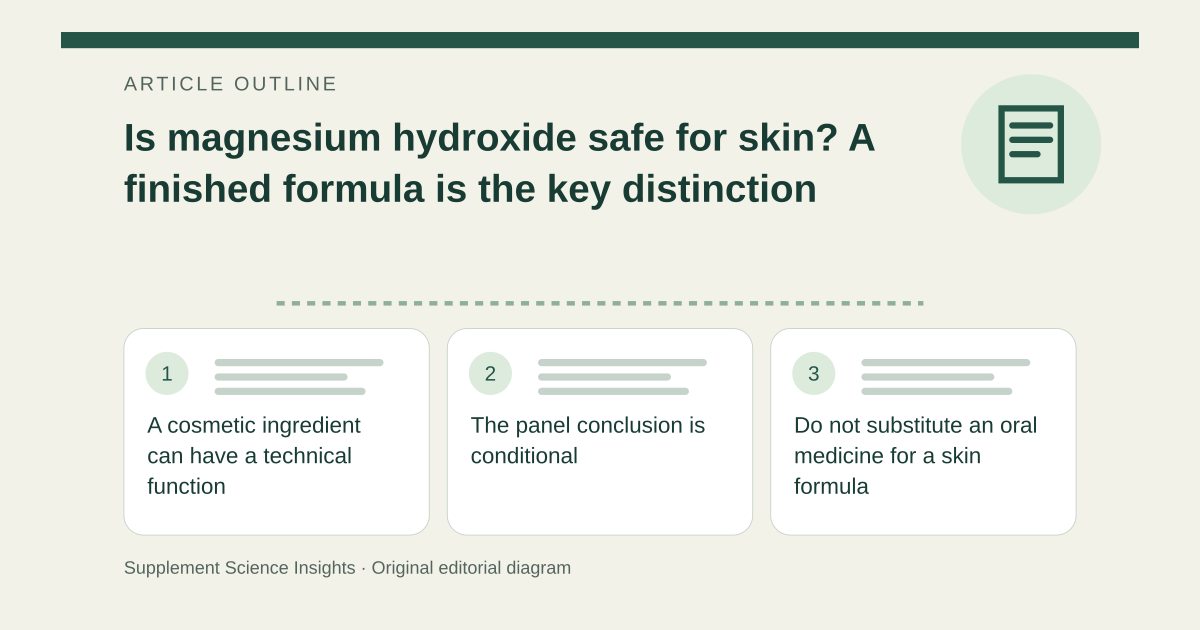
A cosmetic ingredient can have a technical function
The published inorganic-hydroxide assessment describes these alkaline ingredients as pH adjusters. Their presence can help create a particular formulation; it does not itself establish treatment of acne, eczema or an infection. [1][2]
The panel conclusion is conditional
The 2021 assessment concluded that the described uses were safe when products were formulated to be nonirritating, with separate recommended-use and skin-contact precautions for hair straighteners and depilatories. The inspected publisher excerpt supports that formulation-specific conclusion, not unrestricted use of every hydroxide preparation. [1]
Do not substitute an oral medicine for a skin formula
A medicine containing magnesium hydroxide is designed for its labeled route and purpose. Its ingredients and directions do not automatically validate a facial mask, deodorant or leave-on lotion. A cosmetic claim needs evidence for the actual preparation and intended exposure. [2][3]
Homemade mixing can change more than thickness
Adding water or other ingredients can alter preservation and create contamination problems. FDA explains that the water, raw materials, packaging and preservative system all matter. A mixture looking smooth does not establish that it is stable or nonirritating. [4][5]
Choose the product for the skin concern
Imagine someone applies a laxative suspension to a rash after reading that magnesium hydroxide is used in cosmetics. The ingredient comparison does not establish that this use is appropriate. Persistent or worsening skin symptoms deserve cause-specific advice rather than repeated improvised applications. [1][2]
| Product detail | Why it matters |
|---|---|
| Nonirritating finished formula | Condition of the safety assessment |
| Raw powder or oral medicine | Different preparation and instructions |
| Added water | Can affect preservation |
| Disease-treatment claim | Not established by ingredient safety alone |
Sources for this article
- Safety Assessment of Inorganic Hydroxides as Used in Cosmetics (2021)
Source consulted: 2026-09-21. This is a reference resource, not a claim that we conducted the studies or tested a product. - Cosmetics Safety Q&A: Personal Care Products | FDA
Source consulted: 2026-09-21. This is a reference resource, not a claim that we conducted the studies or tested a product. - Magnesium - Health Professional Fact Sheet
Source consulted: 2026-09-21. This is a reference resource, not a claim that we conducted the studies or tested a product. - Microbiological Safety and Cosmetics | FDA
Source consulted: 2026-09-21. This is a reference resource, not a claim that we conducted the studies or tested a product. - Shelf Life and Expiration Dating of Cosmetics | FDA
Source consulted: 2026-09-21. This is a reference resource, not a claim that we conducted the studies or tested a product.