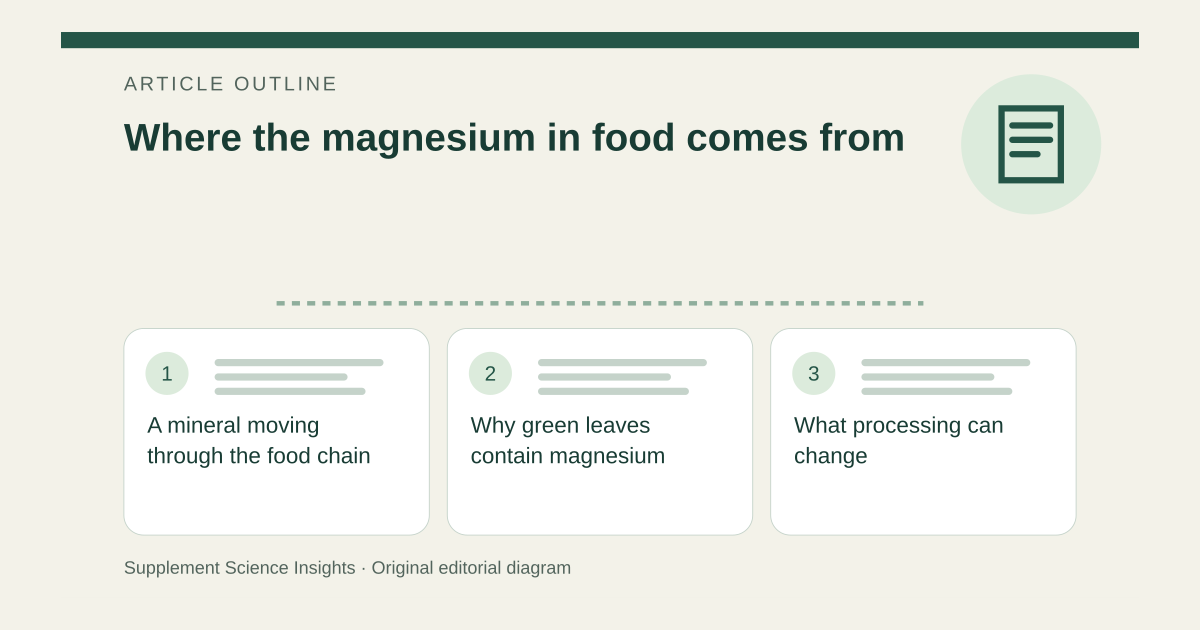
A mineral moving through the food chain
Magnesium is an element. A plant does not manufacture magnesium atoms; it takes up magnesium from its environment and incorporates the mineral into its tissues. University of Minnesota Extension describes how weathering of magnesium-containing minerals makes magnesium available in soil, where some is held on clay and organic matter. [1][2]
The exact supply depends on the growing environment. This origin story does not mean a consumer can infer the magnesium content of a serving from a farm's location, soil color or a “natural” label. Food composition also depends on the crop, edible portion and processing. [1][2]
Why green leaves contain magnesium
Magnesium occupies a central position in chlorophyll, the pigment plants use in photosynthesis. It also participates in plant enzyme systems. That helps explain the connection between magnesium and green leafy foods, but chlorophyll is not the only place magnesium occurs in a diet. [1][2]
NIH lists legumes, nuts, seeds and whole grains alongside leafy vegetables as good sources. Magnesium also occurs in animal foods and beverages. A food does not need to be visibly green to supply it, and greenness alone is not a quantitative nutrient test. [1][2]
What processing can change
Refining a grain can remove magnesium-rich portions such as the bran and germ. This changes how much magnesium remains in the food; it does not destroy the element through a nutritional transformation. Some foods instead have magnesium added during fortification. [2]
These are different routes to a final nutrient amount. For practical food comparisons, use composition information for the form actually eaten rather than assuming that the unprocessed crop and finished product match. The source of a mineral is also a separate question from how much of it is absorbed. [2]
Tracing a hypothetical breakfast
Imagine a breakfast containing whole-grain cereal, nuts and milk. Magnesium can arrive through several foods, not only the cereal's plant pigment. If the cereal is replaced with a refined version, check that product's actual composition and any fortification. The package category by itself cannot tell you the size of the change. [2]
| Stage | What happens |
|---|---|
| Soil minerals | Weathering contributes plant-available magnesium |
| Plant tissue | Magnesium participates in chlorophyll and other systems |
| Refining or fortification | The amount in the finished food can change |
Sources for this article
- Magnesium for crop production | UMN Extension
Source consulted: 2026-09-20. This is a reference resource, not a claim that we conducted the studies or tested a product. - Magnesium - Health Professional Fact Sheet
Source consulted: 2026-09-20. This is a reference resource, not a claim that we conducted the studies or tested a product.