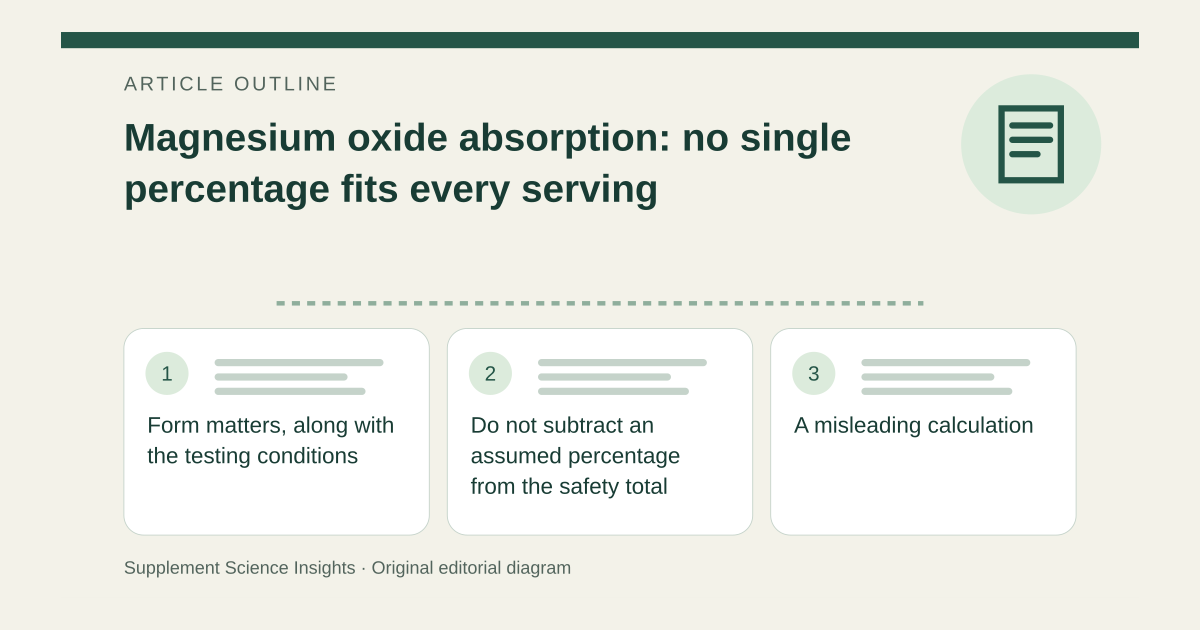
Form matters, along with the testing conditions
ODS reports that citrate, chloride, lactate and aspartate forms tend to be more bioavailable than oxide and sulfate. That comparative statement does not establish that every person absorbs exactly one fixed percentage from every oxide product. Dose, formulation and the method used to estimate absorption matter. [1]
Do not subtract an assumed percentage from the safety total
The supplemental upper limit is expressed as magnesium intake, not a personally calculated absorbed fraction. Multiplying a label amount by an internet absorption estimate does not justify escalating to a much larger intake. Unabsorbed magnesium can itself contribute to gastrointestinal effects. [1]
A misleading calculation
Imagine a label states 400 mg magnesium as oxide and someone assumes only a tiny fraction counts. The labeled intake is still 400 mg elemental magnesium. That amount should be reviewed against the actual purpose and safety context rather than reduced using a universal absorption factor that has not been measured for the individual. [1]
| Example | Interpretation |
|---|---|
| Relative bioavailability | A comparative finding |
| Assumed fixed percentage | Not a personal absorption measurement |
| Labeled elemental amount | Use for the intake calculation |
Sources for this article
- Magnesium - Health Professional Fact Sheet
Source consulted: 2026-09-20. This is a reference resource, not a claim that we conducted the studies or tested a product.