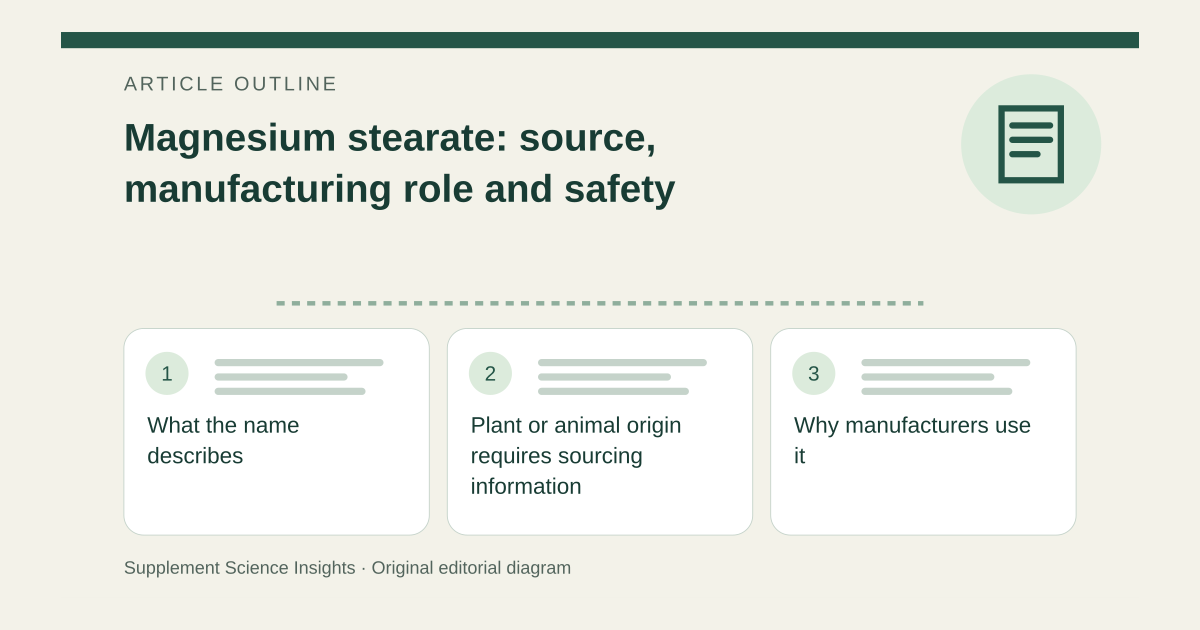
What the name describes
Magnesium stearate is a magnesium salt of stearic acid, a fatty acid. FDA's ingredient inventory lists formulation and free-flow functions, while the cited food regulation describes lubricant, release-agent and processing-aid uses. Those are practical roles in making or handling a product. [1][2]
It is not the same thing as magnesium metal, nor is every appearance of its name a claim that the product supplies a particular nutrient dose. When used among other ingredients, its purpose may be manufacturing rather than correcting magnesium intake. [1][2]
Plant or animal origin requires sourcing information
The chemical name does not identify the original edible fat or oil used to obtain the fatty acid. Vegetable magnesium stearate is a sourcing description indicating a plant-derived fatty-acid source. A documented medicine assessment, for example, explicitly identifies its magnesium stearate as vegetable-derived. [3][4][2]
For a vegan requirement, obtain a supplier or manufacturer statement covering the actual ingredient and finished product. Do not infer the source merely because magnesium itself is a mineral. Also avoid assuming that every generic magnesium-stearate entry represents the same upstream source. [3][4][2]
Why manufacturers use it
A lubricant or release aid can help material move through processing and reduce sticking to equipment. That is distinct from the main ingredient's nutritional or pharmacological purpose. A formulation can contain several ingredients with different roles rather than making every listed ingredient an active treatment. [2][4]
Finished-product performance still requires testing. The presence or absence of magnesium stearate alone cannot establish content uniformity, dissolution or clinical benefit. The EMA example documents separate finished-tablet tests rather than treating an excipient name as the test result. [2][4]
What the safety record means
The cited food regulation recognizes magnesium stearate under specified identity, purity and good-manufacturing-practice conditions. That is useful evidence against treating the ingredient name itself as proof of danger. It is not a license for unlimited quantities or a certificate for an untested retail product. [2]
Conversely, claims that any magnesium stearate inevitably blocks nutrient absorption or harms everyone require relevant evidence. A manufacturing role does not establish those conclusions. This overview does not set a personal intake limit or claim to have independently evaluated every toxicology study. [2]
Is it the same as taking magnesium?
A magnesium salt contains magnesium, but the total mass of the compound differs from the elemental-magnesium amount. NIH explains that declared magnesium amounts on Supplement Facts refer to elemental magnesium. An unquantified excipient listing cannot be treated as an equivalent replacement for a measured magnesium supplement. [5][2]
The practical distinction is the declared nutrient amount and intended use, not whether the word magnesium appears somewhere in the ingredient list. [5][2]
A hypothetical label distinction
Suppose a multivitamin lists magnesium stearate among other ingredients but declares no magnesium nutrient amount. That listing establishes an ingredient, not a quantified magnesium serving. A separate product declaring 100 mg magnesium provides a different kind of information. [5]
| Statement | Meaning |
|---|---|
| Vegetable magnesium stearate | A stated source for the fatty-acid component |
| Magnesium stearate in other ingredients | A formulation ingredient is listed |
| 100 mg magnesium in Supplement Facts | A declared elemental-magnesium amount |
Sources for this article
- Substances Added to Food <em>(formerly EAFUS)</em>
Source consulted: 2026-09-20. This is a reference resource, not a claim that we conducted the studies or tested a product. - 21 CFR 184.1440 — Magnesium stearate (2025 edition)
Source consulted: 2026-09-20. This is a reference resource, not a claim that we conducted the studies or tested a product. - 21 CFR 172.860 — Fatty acids (2025 edition)
Source consulted: 2026-09-20. This is a reference resource, not a claim that we conducted the studies or tested a product. - Circadin, INN-melatonin
Source consulted: 2026-09-20. This is a reference resource, not a claim that we conducted the studies or tested a product. - Magnesium - Health Professional Fact Sheet
Source consulted: 2026-09-20. This is a reference resource, not a claim that we conducted the studies or tested a product.