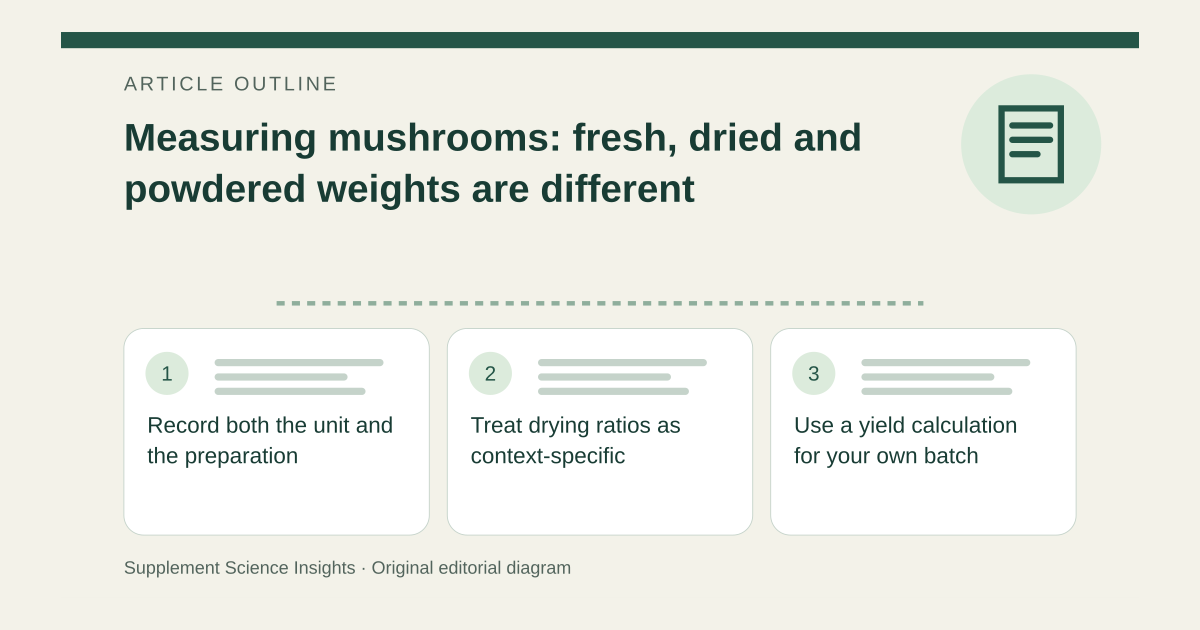
Record both the unit and the preparation
A kitchen scale measures mass; a measuring cup measures volume. Chopping, slicing and grinding change how tightly material packs into a cup. Drying also removes water. These changes explain why a spoonful of one preparation cannot reliably replace the same spoonful of another without a recipe-specific conversion. [1][2]
Treat drying ratios as context-specific
Cornell’s shiitake guidance describes dried mushrooms weighing approximately one seventh of their fresh weight under its stated process. That is not a universal conversion for every species, moisture level or extract powder. An extract may differ further because processing selects or concentrates components rather than merely removing water. [1][3]
Use a yield calculation for your own batch
Imagine 350 g of fresh shiitake yields 50 g after drying. That particular batch has a 7:1 fresh-to-dry mass ratio. A 5 g portion corresponds to 35 g of starting fresh material by this mass accounting, but it does not establish identical nutrient retention or a medical dose. [1]
| Example | Interpretation |
|---|---|
| 350 g fresh becomes 50 g dry | Observed 7:1 batch yield |
| 5 g of that dried batch | 35 g starting fresh mass equivalent |
| A different powder | Needs its own composition and directions |
Sources for this article
- Storage & Preservation - Cornell Small Farms
Source consulted: 2026-09-20. This is a reference resource, not a claim that we conducted the studies or tested a product. - Fruit and Vegetable Guide Series: Mushrooms | USU
Source consulted: 2026-09-20. This is a reference resource, not a claim that we conducted the studies or tested a product. - Dietary Supplements: What You Need to Know
Source consulted: 2026-09-20. This is a reference resource, not a claim that we conducted the studies or tested a product.