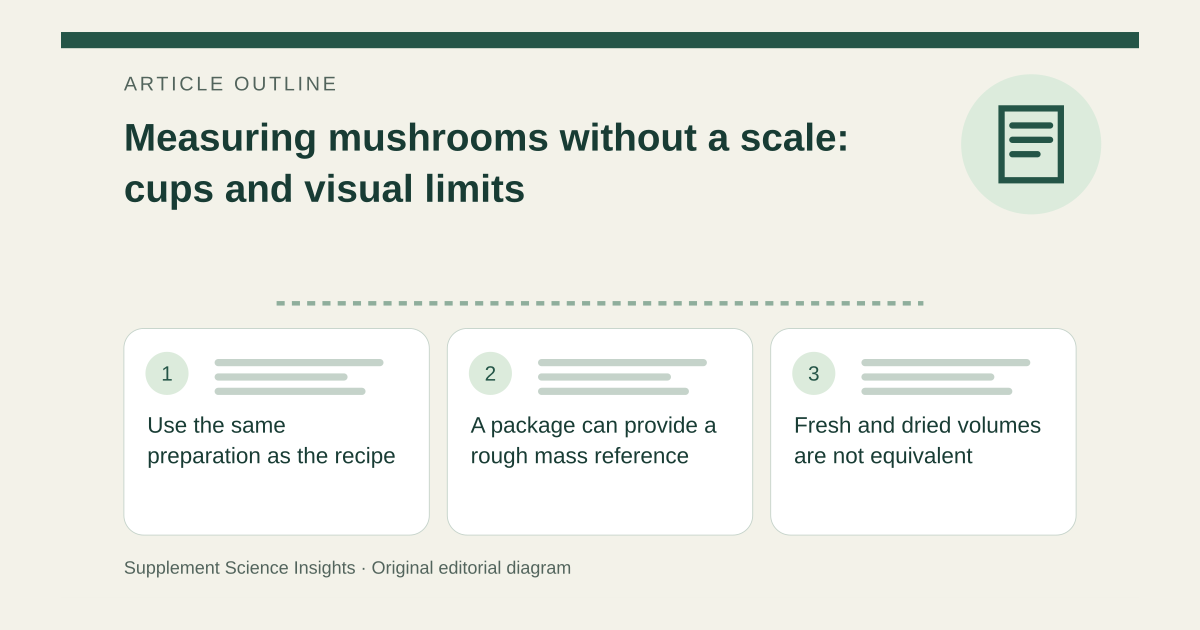
Use the same preparation as the recipe
Clean food mushrooms just before use, then slice or chop as specified. Fill the measuring cup loosely and level it without compressing the pieces. This is a practical kitchen estimate; packing, slice thickness and species change how much fits. [1]
A package can provide a rough mass reference
If a sealed food package states its net weight, dividing its contents into equal portions can approximate a recipe fraction. Unequal mushroom sizes make counting less reliable. For an exact gram requirement, a suitable scale is the better tool. [2]
Fresh and dried volumes are not equivalent
Drying removes water and changes texture and packing. Powder packs differently again, and an extract may concentrate selected constituents. Neither a handful nor a teaspoon reveals the amount of active compounds in an untested product. [3][4]
Keep the estimate appropriate to its purpose
Imagine a soup needs two cups of sliced food mushrooms. Loose cup measures can work because the recipe tolerates variation. The same method cannot establish a safe supplement dose or identify a wild mushroom. [1][3]
| Task | Approach |
|---|---|
| Flexible soup recipe | Matching cup preparation |
| Exact food weight | Scale |
| Fresh-to-dried substitution | Recipe-specific guidance |
| Active-compound dose | Not a visual estimate |
Sources for this article
- Fruit and Vegetable Guide Series: Mushrooms | USU
Source consulted: 2026-09-21. This is a reference resource, not a claim that we conducted the studies or tested a product. - Dietary Supplements: What You Need to Know
Source consulted: 2026-09-21. This is a reference resource, not a claim that we conducted the studies or tested a product. - Preserving mushrooms | OSU Extension Service
Source consulted: 2026-09-21. This is a reference resource, not a claim that we conducted the studies or tested a product. - Mushroom Dietary Supplements
Source consulted: 2026-09-21. This is a reference resource, not a claim that we conducted the studies or tested a product.