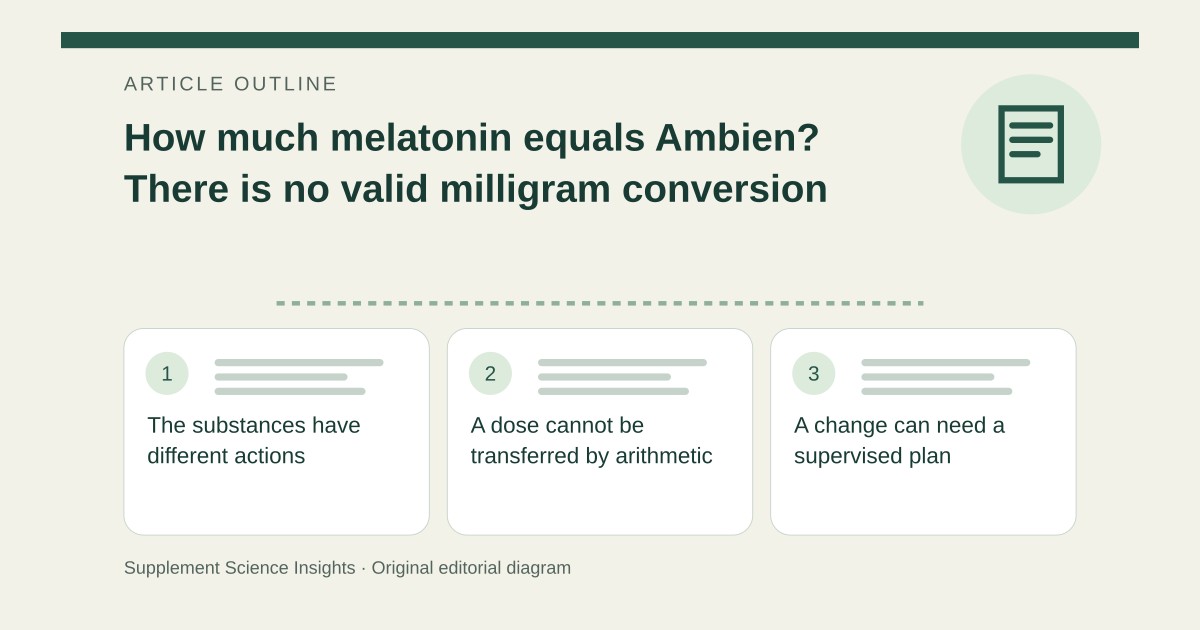
The substances have different actions
Melatonin is a hormone involved in circadian timing. Ambien contains zolpidem, a sedative-hypnotic medicine that slows brain activity to allow sleep. A shared aim of helping sleep does not create a common potency scale. [1][2]
A dose cannot be transferred by arithmetic
Zolpidem products differ in release and intended use, while melatonin evidence depends on the sleep condition and timing. Neither source provides a reliable equivalence formula. More melatonin should not be used to imitate the number printed on an Ambien prescription. [1][2]
A change can need a supervised plan
Zolpidem can be habit forming, and abrupt stopping after ongoing use can cause withdrawal symptoms. It also carries a serious warning for complex sleep behaviors such as sleep-driving. If such behavior occurs, stop zolpidem and contact the doctor immediately, as the medication guidance directs. [2]
Ask about the sleep problem rather than an equivalent dose
Imagine someone wants to replace nightly Ambien with a supplement. Discuss how long zolpidem has been used, the formulation and whether the problem is falling asleep, staying asleep or circadian timing. The prescriber can plan the change; a conversion chart cannot. [2][1]
| Label or question | Meaning |
|---|---|
| Milligrams on two labels | Not a shared potency measure |
| Long-term zolpidem use | Discuss a supervised change |
| Complex sleep behavior | Stop zolpidem and contact the doctor promptly |
Sources for this article
- Melatonin: What You Need To Know | NCCIH
Source consulted: 2026-09-20. This is a reference resource, not a claim that we conducted the studies or tested a product. - Zolpidem: MedlinePlus Drug Information
Source consulted: 2026-09-20. This is a reference resource, not a claim that we conducted the studies or tested a product.