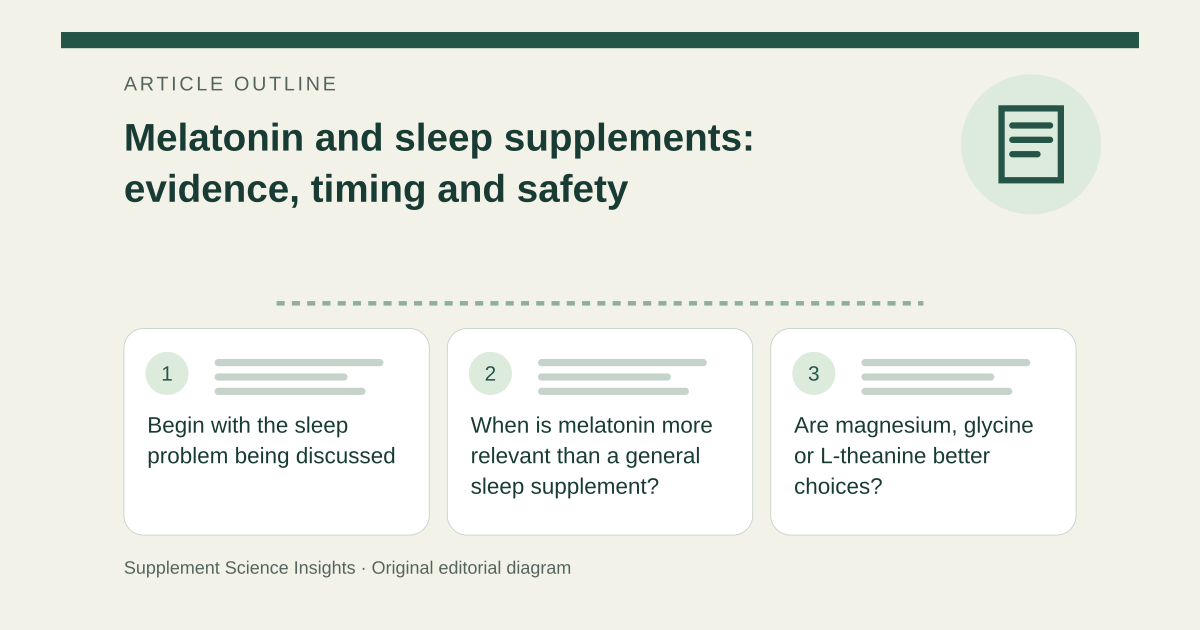
Begin with the sleep problem being discussed
Melatonin is a hormone involved in the timing of circadian rhythms and sleep. NCCIH distinguishes several research settings, including jet lag and delayed sleep-wake phase disorder. A general phrase such as “better sleep” does not identify a single study question. [1]
Write down the intended question before examining a product. Is it about a changed travel schedule, a persistent difficulty sleeping or another situation? This page helps organize evidence; it does not diagnose a sleep disorder or select a treatment time. [1]
When is melatonin more relevant than a general sleep supplement?
Melatonin is most usefully considered in relation to sleep timing. Jet lag and delayed sleep-wake timing differ from chronic insomnia, repeated awakenings or an unexplained need to sleep during the day. A positive study in one setting does not answer all the others. [2]
NCCIH notes that major clinical guidelines have recommended against using melatonin for chronic insomnia because the evidence is insufficient. Cognitive behavioral therapy for insomnia is the most strongly recommended treatment. Persistent sleep problems, especially snoring with breathing pauses or marked daytime sleepiness, deserve assessment rather than a stronger supplement stack. [2]
Are magnesium, glycine or L-theanine better choices?
“Melatonin-free” describes the ingredients, not the strength of the evidence or the absence of next-day effects. Research on magnesium for insomnia is limited and inconsistent; it does not establish a best magnesium form or a reliable time to benefit. Evidence for valerian and other complementary sleep products is also inconsistent or too limited for a confident general recommendation. [2]
Glycine and L-theanine have small human studies, but a small favorable study cannot rank them against each other or against melatonin for a different sleep complaint. Compare the tested preparation, participants, outcome and duration before accepting a “best for sleep” label. The detailed ingredient pages below separate those research questions. [2]
Why dose, timing and release form belong together
There is no single melatonin dose or bedtime interval that fits every sleep problem. The timing used to shift a delayed body clock can differ from the timing used for travel. More milligrams do not resolve that mismatch. [1]
Immediate-release and prolonged-release preparations produce different exposure patterns. A longer release is not proof that a retail supplement will prevent nighttime awakenings. Record the exact formulation and follow the product and clinician instructions; do not assume a modified-release tablet can be split or crushed. A morning hangover is a reason to reassess the plan, not add another stimulant. [1]
What makes a melatonin product comparison useful?
Check the declared amount per serving, release form, other active ingredients and independently verifiable quality information. Gummies, tablets and liquids should be compared on actual serving instructions. Flavor and convenience do not verify the measured contents. [3]
A blinded assay published in JAMA examined 25 U.S. melatonin gummy products; 22 were inaccurately labeled under the study’s criterion. This was a sampled-market study, not proof about every current gummy or a finding that every tablet is accurate. It makes exact-product testing more useful than assuming format alone establishes reliability. [3]
Two sleep studies can answer different questions
Imagine Study A recruits adults crossing time zones and measures daytime jet-lag symptoms. Study B recruits adults with persistent insomnia and measures time to fall asleep over repeated nights. Even if both investigate melatonin, their populations and outcomes differ.
A favorable result in the invented Study A would not automatically answer Study B’s question. Compare the reason for use, preparation, timing, outcome and follow-up. No result or dose is supplied here; these are fictional study descriptions used to show an evidence mismatch.
| Field | Study A | Study B |
|---|---|---|
| Population | Adults crossing time zones | Adults with persistent insomnia |
| Outcome | Daytime jet-lag symptoms | Time to fall asleep |
| Question answered | Travel-related symptoms | Repeated sleep-onset difficulty |
| Transferability | Not automatic | Not automatic |
Safety is not settled by the word natural
NCCIH reports limited information on long-term melatonin safety. Short-term side effects can include sleepiness, headache, dizziness and nausea. People with epilepsy or taking blood thinners need medical supervision when using melatonin; pregnancy and breastfeeding safety research is limited. [1]
Consult a clinician about the full context and medicine list. Do not interpret an absence of a warning on a shopping image as proof of suitability. Persistent or worsening sleep problems deserve assessment rather than an unreviewed escalation of supplements. [1]
Keep child use and storage as explicit questions
NCCIH advises parents to speak with a health care provider before giving a child melatonin and to keep supplements out of children’s reach and sight. Adult evidence and packaging do not establish a child’s treatment plan. [1]
For a household record, note the exact preparation and who it is intended for. Store the product securely rather than treating a flavored format as ordinary candy. This page provides no pediatric dose or schedule. [1]
The label is a declaration, not a batch assay
Record the labeled amount, serving units, formulation, other ingredients and any independently documented quality information. A current batch-specific report and a generic marketing statement are different kinds of evidence.
Ask what was tested, by whom, for which batch and with what method. A clear label is useful for identification, but it does not itself verify the measured contents. Keep composition verification separate from evidence that the product improves the intended sleep outcome.
How to use this evidence
Use the sections above to match a question with the preparation, population and outcome actually studied. Follow the related reading for more detailed questions; a useful comparison may still end with uncertainty rather than a winning product.
This is an editorial evidence guide, not a systematic review or individual medical advice. No new clinical review credentials, product tests or personal treatment plan are implied. Study protocols and fictional value examples are identified as such.
Sources for this article
- NIH NCCIH — Melatonin: What You Need To Know
Source consulted: 2026-09-17. This is a reference resource, not a claim that we conducted the studies or tested a product. - NCCIH — Sleep Disorders and Complementary Health Approaches
Source consulted: 2026-10-28. This is a reference resource, not a claim that we conducted the studies or tested a product. - Cohen et al. — Quantity of Melatonin and CBD in Melatonin Gummies Sold in the US
Source consulted: 2026-10-28. This is a reference resource, not a claim that we conducted the studies or tested a product.
Considering a supplement?
Ingredient evidence alone does not establish which retail product is suitable. No single featured product is recommended for this article.
Compare melatonin formulations (retail checks pending) → No overall winner
Compare formulations → · How we select products