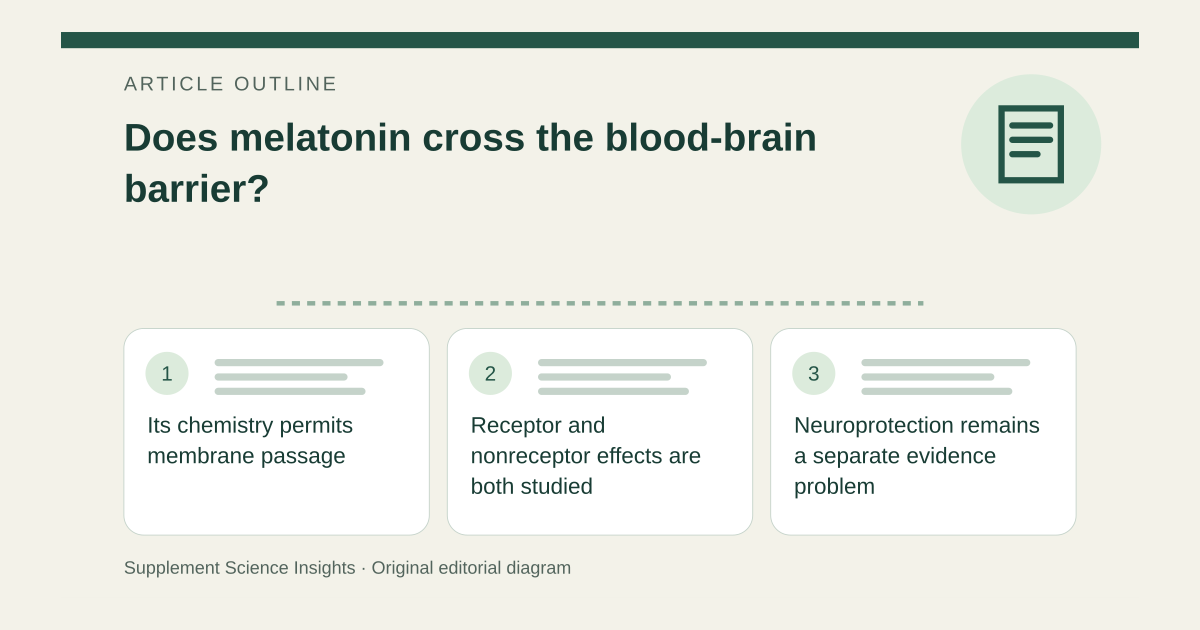
Its chemistry permits membrane passage
The reviewed literature describes melatonin as amphiphilic, with properties that allow movement across cellular membranes, including the blood-brain barrier. This is different from assuming that every substance labeled an antioxidant reaches brain tissue in the same way. [1]
Receptor and nonreceptor effects are both studied
Endotext describes MT1 and MT2 receptor signaling as well as nonreceptor-mediated actions. These help explain biological activity, but the concentration, timing and tissue context determine the response. Crossing a barrier does not specify the amount needed for a clinical outcome. [2]
Neuroprotection remains a separate evidence problem
Mechanistic reviews discuss oxidative stress, mitochondria and inflammation, often using experimental models. The recent review also notes small clinical groups and the need for larger, well-designed studies. Those limitations prevent treating brain penetration as proof of disease prevention. [1]
Avoid a dose inference from a transport fact
Imagine an advertisement says a large dose must protect the brain because melatonin enters it. The conclusion does not follow. Use melatonin only for an appropriate purpose with attention to adverse effects and interactions, rather than escalating it to chase an unproven neurological benefit. [3][1]
| Finding | What remains unknown |
|---|---|
| Crosses the barrier | Effective dose for a disease |
| Acts on receptors | Individual clinical response |
| Antioxidant mechanism | Long-term neurological benefit |
| Higher exposure | Not automatically better protection |
Sources for this article
- Melatonin—A Powerful Antioxidant in Neurodegenerative Diseases - PMC
Source consulted: 2026-09-21. This is a reference resource, not a claim that we conducted the studies or tested a product. - Physiology of the Pineal Gland and Melatonin - Endotext - NCBI Bookshelf
Source consulted: 2026-09-21. This is a reference resource, not a claim that we conducted the studies or tested a product. - Melatonin: What You Need To Know | NCCIH
Source consulted: 2026-09-21. This is a reference resource, not a claim that we conducted the studies or tested a product.