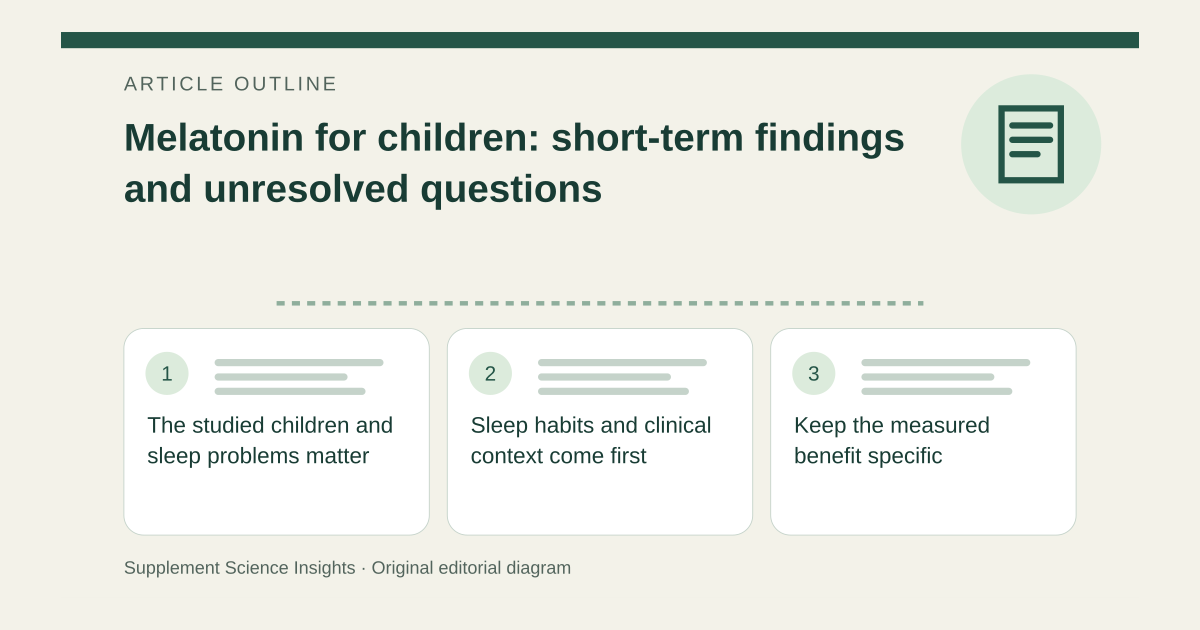
The studied children and sleep problems matter
NCCIH describes a 2019 review of 18 studies involving 1,021 children. Most studies were small, and their durations ranged from one to thirteen weeks. Overall, melatonin improved time to fall asleep and total sleep compared with placebo. [1]
Effects on behavior and daytime functioning were less clear. A change in sleep timing should not be relabeled as treatment of autism, ADHD or every daytime difficulty in a child with those diagnoses. [1]
Sleep habits and clinical context come first
The source describes condition-specific guidance that begins with behavioral approaches such as bedtime habits and parent education, sometimes supplemented with medicine. It recommends speaking with a health care provider before giving a child melatonin. [1]
The appropriate response depends on why sleep is difficult. A product marketed for children does not establish that it is suitable for every age or every sleep pattern. [1]
Keep the measured benefit specific
Imagine a child in a study falls asleep sooner but has no measured change in daytime behavior. Reporting a sleep-onset benefit preserves the finding; calling it a general behavioral treatment does not.
The study also cannot establish years of safety when follow-up lasted only weeks.
| Detail | Meaning |
|---|---|
| Time to fall asleep | A measured sleep endpoint |
| Daytime functioning | A different outcome |
| Years of developmental safety | Not answered by a short trial |
Long-term development and accidental ingestion remain concerns
NCCIH notes limited information on long-term effects, including uncertainty about hormonal development. It also emphasizes safe storage because children can ingest melatonin products without supervision. [1]
Keep supplements out of children’s reach and sight. This page does not provide a pediatric dose, endorse a gummy brand or treat reassuring short-term findings as proof of lifelong safety. [1]
Sources for this article
- NCCIH: Melatonin—What You Need To Know
Source consulted: 2026-09-17. This is a reference resource, not a claim that we conducted the studies or tested a product.