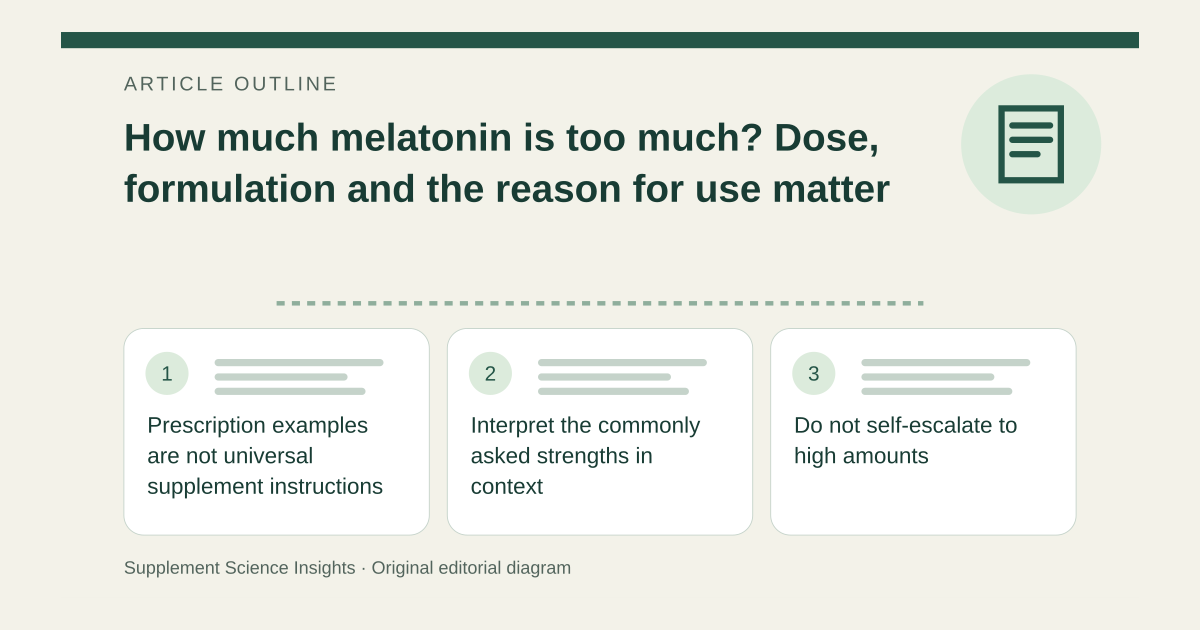
Prescription examples are not universal supplement instructions
NHS guidance describes 2 mg slow-release melatonin for short-term adult insomnia. It also describes specialist-supervised regimens up to 10 mg for certain longer-term sleep problems and a different immediate-release regimen for jet lag. These UK medicine instructions cannot be turned into a universal U.S. over-the-counter dose or toxicity threshold. [1]
Interpret the commonly asked strengths in context
Amounts such as 2.5, 3, 5 or 6 mg may appear in products or particular regimens, but that does not establish that they are needed or appropriate for you. The same applies to 9 or 10 mg. A higher number is not proof of greater benefit, and a lower number does not eliminate interactions or next-day impairment. [1][2]
Do not self-escalate to high amounts
Doses such as 12, 15, 20, 36, 50 or 100 mg are not justified as routine sleep self-treatment by the cited guidance. There is no defensible table that labels each amount harmless or fatal for everyone. If already taken beyond instructions, use poison advice rather than waiting for an online cutoff to be crossed. [1][3]
Count the amount per unit and the total
Two tablets are not a dose until the strength of each is known: two 1 mg tablets total 2 mg, while two 5 mg gummies total 10 mg. Check whether the label lists an amount per gummy or per serving. One gram equals 1,000 mg; grams are not interchangeable with milligrams. These calculations describe exposure, not a recommendation to take it. [4]
Side effects and vulnerable groups change the decision
Melatonin can cause daytime sleepiness, headache, dizziness or unusual dreams. Long-term safety information is limited, and children, pregnancy, epilepsy and blood-thinner use require particular clinical review. Supplement content can differ from the label, adding uncertainty to an apparently precise number. [5][2]
Get individualized help after a concerning excess
In the U.S., call Poison Control at 1-800-222-1222 or use webPOISONCONTROL for a possible overdose. Keep the package, amount, time and other substances available. Call emergency services for collapse, seizure, breathing difficulty or inability to awaken. Do not drive while impaired. [3][6]
| Hypothetical label | Total for two units |
|---|---|
| 1 mg per tablet | 2 mg |
| 2.5 mg per gummy | 5 mg |
| 5 mg per gummy | 10 mg |
Sources for this article
- How and when to take melatonin - NHS
Source consulted: 2026-09-20. This is a reference resource, not a claim that we conducted the studies or tested a product. - Melatonin: What You Need To Know | NCCIH
Source consulted: 2026-09-20. This is a reference resource, not a claim that we conducted the studies or tested a product. - Potential uses and benefits of melatonin | Poison Control
Source consulted: 2026-09-20. This is a reference resource, not a claim that we conducted the studies or tested a product. - Dietary Supplements: What You Need to Know
Source consulted: 2026-09-20. This is a reference resource, not a claim that we conducted the studies or tested a product. - Side effects of melatonin - NHS
Source consulted: 2026-09-20. This is a reference resource, not a claim that we conducted the studies or tested a product. - Poison Control: First aid guidelines
Source consulted: 2026-09-20. This is a reference resource, not a claim that we conducted the studies or tested a product.