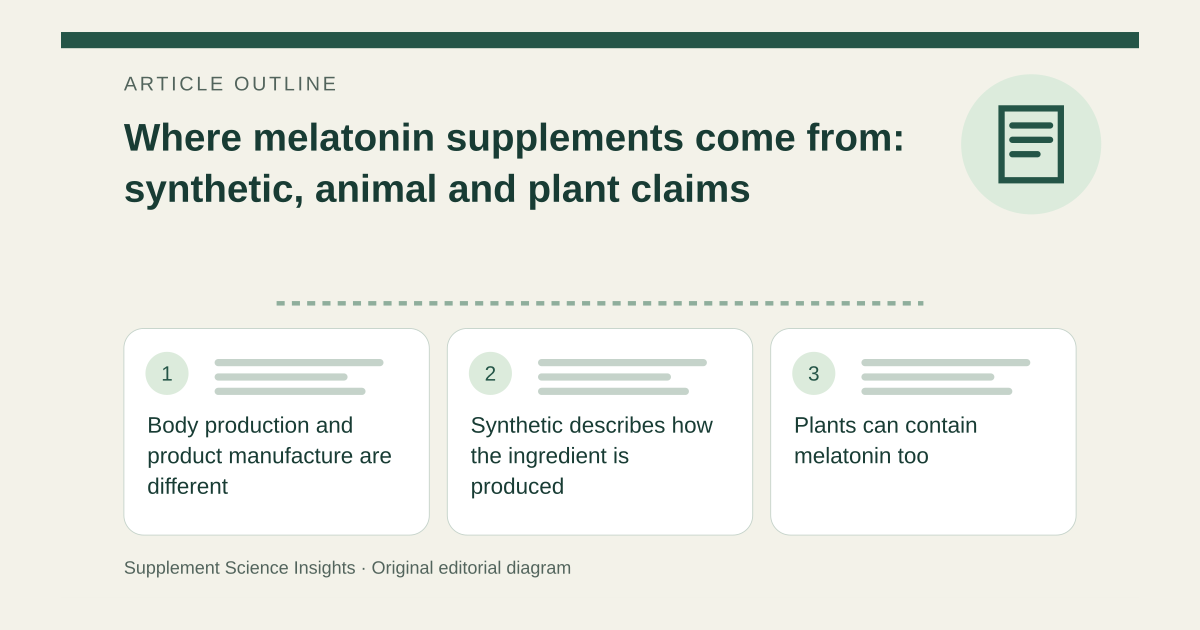
Body production and product manufacture are different
Melatonin participates in the body’s sleep-wake signaling. A finished supplement is a manufactured product with a declared ingredient amount and other ingredients. The fact that the body produces the molecule does not make every manufactured preparation equivalent or automatically safe. [1][2]
Synthetic describes how the ingredient is produced
The EMA public assessment of Circadin describes a synthetic active ingredient used in a controlled finished medicine. This is one documented example, not the recipe for every supplement. Source identity, purity, amount and release characteristics remain separate product questions. [3]
Plants can contain melatonin too
A review of melatonin in plants documents its occurrence and plant biosynthesis. That establishes a biological source category, not that every plant extract supplies a consistent useful dose or works better than a synthetic preparation. A plant-based front label needs a specific ingredient declaration and supporting evidence. [4]
Natural is not a safety or effectiveness ranking
NCCIH describes limits to long-term melatonin safety knowledge and possible adverse effects. Those concerns are not resolved by choosing a natural-sounding source. Check the full formula, suitability and intended use rather than assuming one origin guarantees better sleep. [1]
Ask a source claim to identify the product
Imagine two bottles both declare melatonin, but one additionally advertises plant origin. Ask what ingredient is standardized, what amount is supplied and what evidence applies to that formulation. The origin claim alone does not establish a clinical advantage. [2][4]
| Claim | What it establishes |
|---|---|
| Synthetic origin | A manufacturing description |
| Plant origin | A source claim requiring documentation |
| Improves sleep | A separate clinical outcome claim |
Sources for this article
- Melatonin: What You Need To Know | NCCIH
Source consulted: 2026-09-21. This is a reference resource, not a claim that we conducted the studies or tested a product. - Questions and Answers on Dietary Supplements | FDA
Source consulted: 2026-09-21. This is a reference resource, not a claim that we conducted the studies or tested a product. - Circadin, INN-melatonin
Source consulted: 2026-09-21. This is a reference resource, not a claim that we conducted the studies or tested a product. - Melatonin and Phytomelatonin: Chemistry, Biosynthesis, Metabolism, Distribution and Bioactivity in Plants and Animals-An Overview - PubMed
Source consulted: 2026-09-21. This is a reference resource, not a claim that we conducted the studies or tested a product.