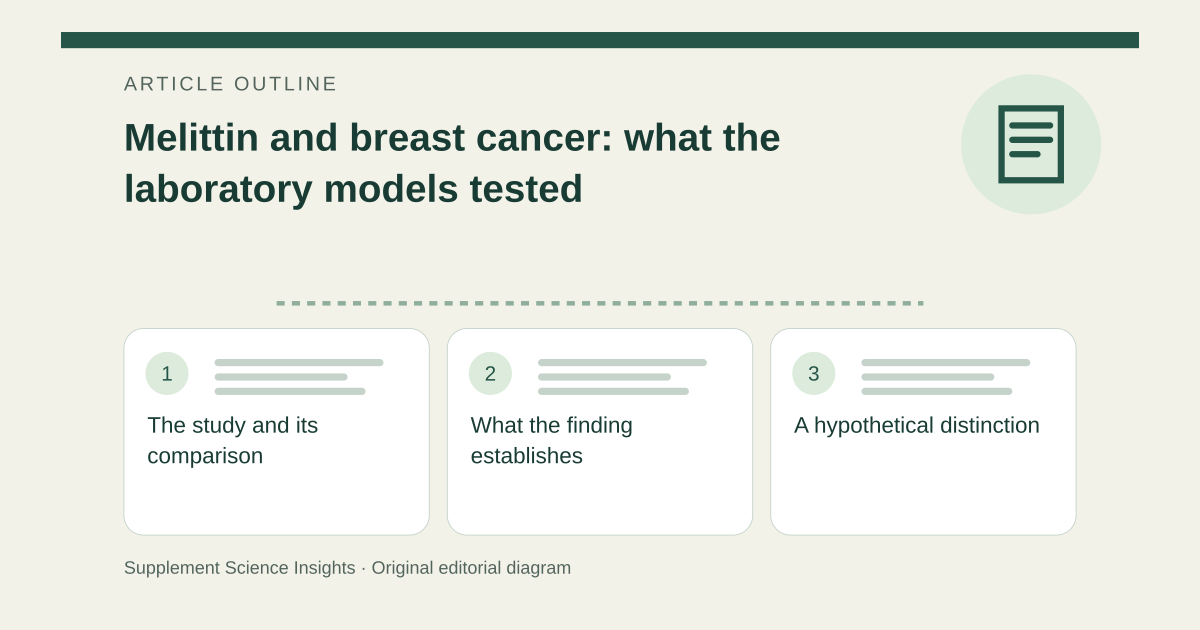
The study and its comparison
Researchers tested honeybee venom and melittin against breast-cancer cell lines, including triple-negative and HER2-enriched subtypes. They examined receptor signaling, membrane interactions and engineered versions of the peptide. [1]
The report found cell death and reduced activation of selected growth-factor receptors. Melittin also enhanced docetaxel’s effect on tumor growth in an allograft model. [1]
What the finding establishes
Those experiments do not show that swallowing melittin or using bee venom treats human cancer. Route, delivery, toxicity and patient benefit remain separate questions. Exact sample counts and exposures were not established from the abstract. Disclosures included industry funding relationships and a shareholding; complete funding was not established. This is a research interpretation, not a treatment method. [1]
A hypothetical distinction
Imagine a peptide reaches cells directly in an experiment. An oral product has not thereby demonstrated the same exposure or effect.
| Detail | Interpretation |
|---|---|
| Measured outcome | Keep the endpoint specific |
| Study preparation | Not every retail product |
| Remaining uncertainty | Not resolved by a mechanism |
Sources for this article
- Honeybee venom and melittin suppress growth factor receptor activation in HER2-enriched and triple-negative breast cancer.
Source consulted: 2026-09-19. This is a reference resource, not a claim that we conducted the studies or tested a product.