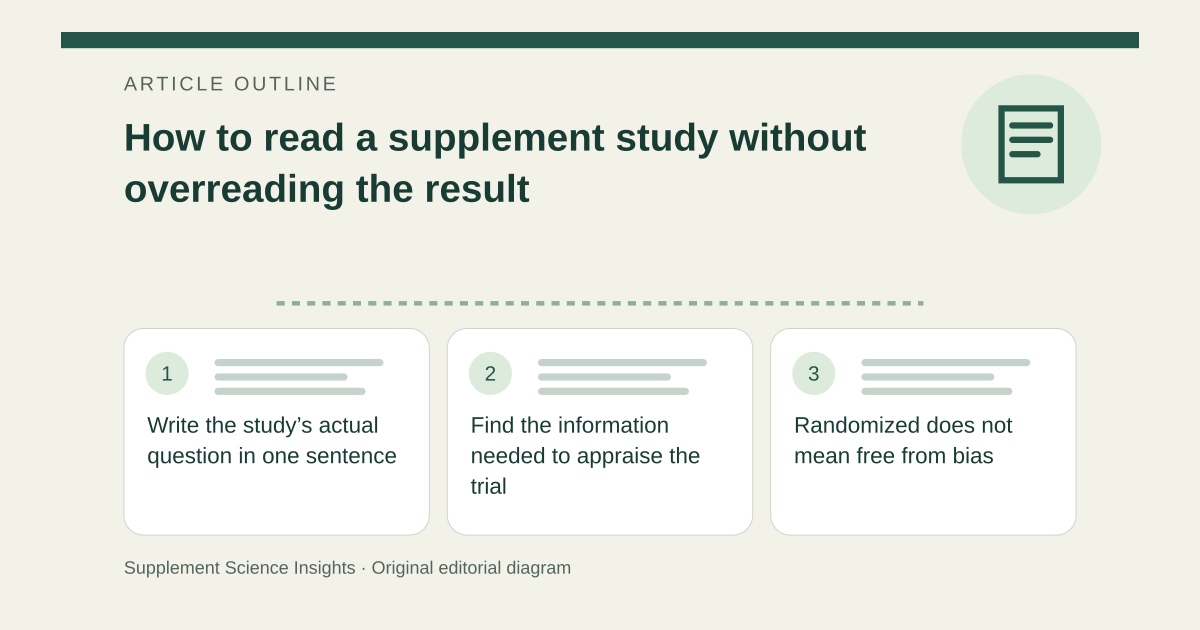
Write the study’s actual question in one sentence
Before reading the conclusion, identify who participated, what they received, what it was compared with, how long they were followed and which outcome was measured. Keep the supplement formulation and dose attached to that sentence. This creates a boundary around the result you are evaluating.
A useful editorial test is whether the claim can be restated without changing any of those elements. If a headline broadens one population into “everyone,” or one preparation into an entire category, note the extrapolation rather than silently adopting it.
Find the information needed to appraise the trial
CONSORT 2025 is a reporting guideline for randomized trials. It calls for information including registration, protocol, participant flow, interventions, outcomes, analyses, harms and interests. Use it to locate information, not to award a supplement an efficacy certificate. [1]
Missing information should remain visible in your notes. “Not reported in the paper inspected” is more accurate than assuming that a method was used because it would have been sensible. [1]
Randomized does not mean free from bias
Cochrane’s RoB 2 framework examines a specific trial result through five domains: randomization, deviations from intended interventions, missing data, outcome measurement and selection of the reported result. Judgments need reasons grounded in the available study information. [2]
For a reading worksheet, note where participants were lost, whether the measured outcome matches the planned one and whether the assessment could have been influenced by knowledge of treatment. A full risk-of-bias assessment takes more work than checking that “randomized” appears in the title. [2]
Read absolute and relative numbers together
The following numbers are invented solely to explain arithmetic. They are not results from a supplement trial. Suppose 10 of 100 people in one group and 20 of 100 in another experience the same defined event over the same period.
The event risks are 10% and 20%. The absolute difference is 10 percentage points. Dividing 10% by 20% gives a risk ratio of 0.5, corresponding to a 50% relative reduction. “Half the risk” and “10 fewer events per 100 people” describe these same hypothetical counts.
The calculation still does not establish causation, reliability or applicability. A real study needs its design, uncertainty, follow-up and missing-data context assessed. Do not treat the precision of a calculated percentage as certainty about an effect.
| Calculation | Example result |
|---|---|
| Group A event risk | 10 / 100 = 10% |
| Group B event risk | 20 / 100 = 20% |
| Absolute difference | 20% − 10% = 10 percentage points |
| Risk ratio | 10% / 20% = 0.5 |
| Relative reduction | 1 − 0.5 = 50% |
Keep uncertainty, harms and relevance beside the estimate
Record the effect estimate and its interval, not just whether a statistical threshold was crossed. Read harms alongside benefits, and distinguish planned analyses from later exploratory ones. CONSORT also calls for discussion of limitations and generalizability. [1]
Then ask what the measured difference would mean to a reader in the study’s circumstances. A change in a laboratory measure, a symptom score and a major health event are different outcomes. Avoid substituting one for another in the article headline. [1]
Check the wider record before writing a conclusion
Find the trial registration and protocol where available; note funding and author conflicts, and check the publisher’s record for corrections or retractions. These are prompts for further inspection, not automatic reasons to accept or dismiss a result. [1]
Conclude with the narrowest defensible statement and identify what evidence was not assessed. This guide evaluates how to read a study; it does not independently appraise a supplement trial or establish a treatment recommendation. A single persuasive abstract is not enough to complete an evidence review. [1]
Sources for this article
- Hopewell et al. — CONSORT 2025 statement, BMJ 389:e081123
Source consulted: 2026-09-17. This is a reference resource, not a claim that we conducted the studies or tested a product. - Cochrane Handbook — Assessing risk of bias in a randomized trial
Source consulted: 2026-09-17. This is a reference resource, not a claim that we conducted the studies or tested a product.