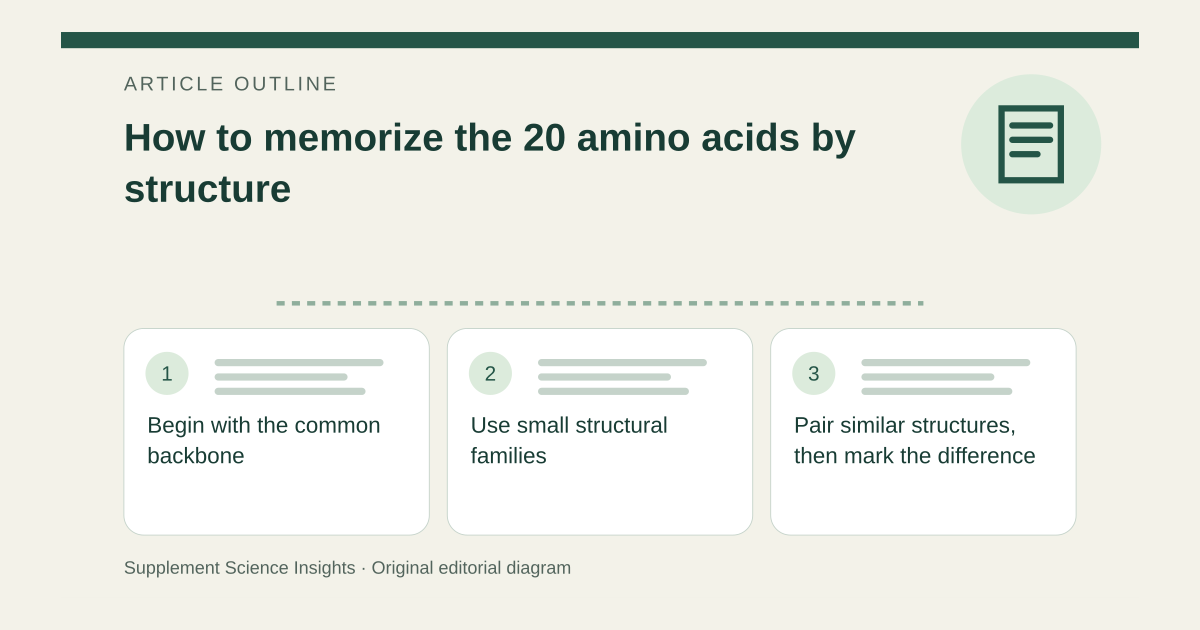
Begin with the common backbone
For the 20 common protein amino acids, learn the alpha-carbon framework first: an amino group, a carboxyl group, a hydrogen and a variable side chain. At physiological pH the amino and carboxyl groups are usually charged, so practice the zwitterionic representation as well as the neutral drawing. [1]
Two early exceptions make useful anchors. Glycine has hydrogen as its side chain and no chiral alpha carbon. Proline's side chain loops back to the nitrogen, making its amino group part of a ring. Learning these features is more useful than trying to memorize 20 unrelated pictures. [1]
Use small structural families
Start with glycine, alanine, valine, leucine and isoleucine: G, A, V, L and I. Move from hydrogen to a methyl group, then to branched hydrocarbon side chains. Compare leucine and isoleucine by locating the branch rather than treating their similar names as the only clue. [1]
Add methionine, M, with its sulfur-containing chain, and proline, P, with its ring back to nitrogen. These seven can form a practical nonpolar-side-chain study set. The memory cue GAVLIMP is an original ordering aid here, not a formal chemical classification. [1]
Pair similar structures, then mark the difference
Serine, S, and threonine, T, both have hydroxyl-containing side chains; threonine adds a methyl branch. Cysteine, C, has a thiol group. Asparagine, N, and glutamine, Q, have amide side chains, with glutamine one methylene group longer. [1]
Compare those amides with aspartate, D, and glutamate, E, whose side chains contain carboxylate groups at ordinary physiological pH. The short-versus-long pair remains the same: aspartate and asparagine are shorter; glutamate and glutamine are longer. Practice the charge difference explicitly. [1]
Finish the rings and basic side chains
Phenylalanine, F, has a benzyl side chain. Tyrosine, Y, adds a hydroxyl to that aromatic ring. Tryptophan, W, has a larger fused indole ring. Grouping these three by aromatic structure is useful, while remembering that tyrosine's hydroxyl changes its chemical behavior. [1]
The basic-side-chain set is lysine, K, arginine, R, and histidine, H. Lysine ends in an amino group, arginine in a guanidino group and histidine contains an imidazole ring. Their charge behavior is pH-dependent; histidine should not be memorized as permanently carrying the same charge as lysine. [1]
Turn the reference into a recall exercise
Draw the shared backbone, choose a code at random and add its side chain from memory. Check the number of methylene groups, heteroatoms, ring structure and charge against the reference. On a second pass, work in reverse from a drawing to the full name and code. [1]
The suggested grouping is a learning device. It does not replace your course's classification scheme, which may place borderline or multifunctional side chains differently. Confirm that your set contains all 20 exactly once, and give the easily confused pairs extra attention. [1]
A hypothetical short practice session
Imagine a learner repeatedly confuses N with D and Q with E. Instead of repeating the alphabet list, they draw the shorter and longer side chains as two pairs, then change the terminal amide to a carboxylate. That exercise targets the actual structural error. The table gives a compact checklist for an original study session. [1]
| Study set | Members and structural cue |
|---|---|
| Small and branched chains | Gly G; Ala A; Val V; Leu L; Ile I |
| Special nonpolar structures | Met M: sulfur chain; Pro P: ring to nitrogen |
| Hydroxyl and thiol | Ser S; Thr T; Cys C |
| Amide pair | Asn N; Gln Q |
| Acidic pair | Asp D; Glu E |
| Aromatic set | Phe F; Tyr Y; Trp W |
| Basic set | Lys K; Arg R; His H |
Sources for this article
- 26.1 Structures of Amino Acids - Organic Chemistry | OpenStax
Source consulted: 2026-09-20. This is a reference resource, not a claim that we conducted the studies or tested a product.