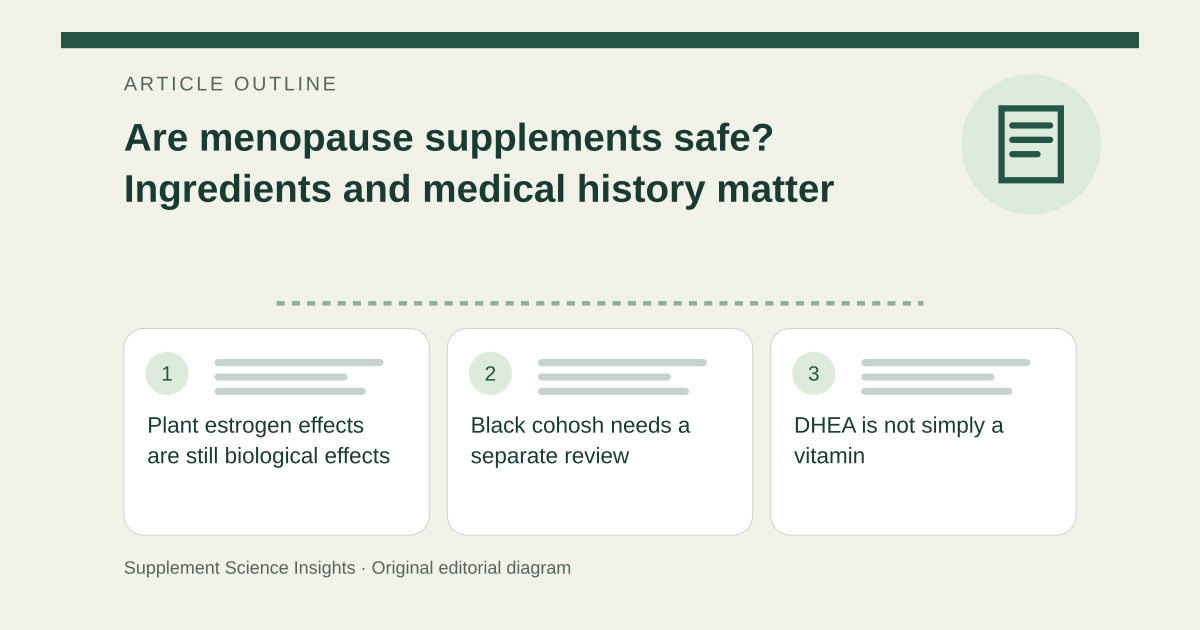
Plant estrogen effects are still biological effects
Soy and red-clover isoflavones are phytoestrogens: plant substances with structures resembling estrogen. Their long-term safety as supplements is not established. NCCIH cautions that estrogen-like effects may make these products unsuitable for people who should not take estrogen. Food use and concentrated supplement use should not automatically receive the same assessment. [1]
Black cohosh needs a separate review
Rare, sometimes serious liver problems have been reported with products labeled black cohosh, although causation is uncertain. Product misidentification has also occurred. NCCIH advises contacting a clinician for symptoms such as dark urine or fatigue during use and notes uncertainty in people with hormone-sensitive conditions. Black cohosh and blue cohosh are different plants. [2]
DHEA is not simply a vitamin
The body can convert DHEA into testosterone and estrogen. Its usefulness for menopause symptoms is uncertain and long-term supplement safety is unknown. This is a reason for a medical review, not a rationale to increase the amount until a hormone-related effect appears. [1]
Review the complete blend before starting
Imagine a blend contains black cohosh, soy isoflavones and DHEA. A safety statement about only one ingredient does not clear the whole combination. Bring the full label and medicine list to a pharmacist or clinician, especially with liver disease or a hormone-sensitive condition. [2][1]
| Ingredient | Question to resolve |
|---|---|
| Black cohosh | Liver history and actual plant identity |
| Isoflavones or DHEA | Hormone-related suitability |
Sources for this article
- Menopausal Symptoms: In Depth | NCCIH
Source consulted: 2026-09-20. This is a reference resource, not a claim that we conducted the studies or tested a product. - Black Cohosh: Usefulness and Safety | NCCIH
Source consulted: 2026-09-20. This is a reference resource, not a claim that we conducted the studies or tested a product.