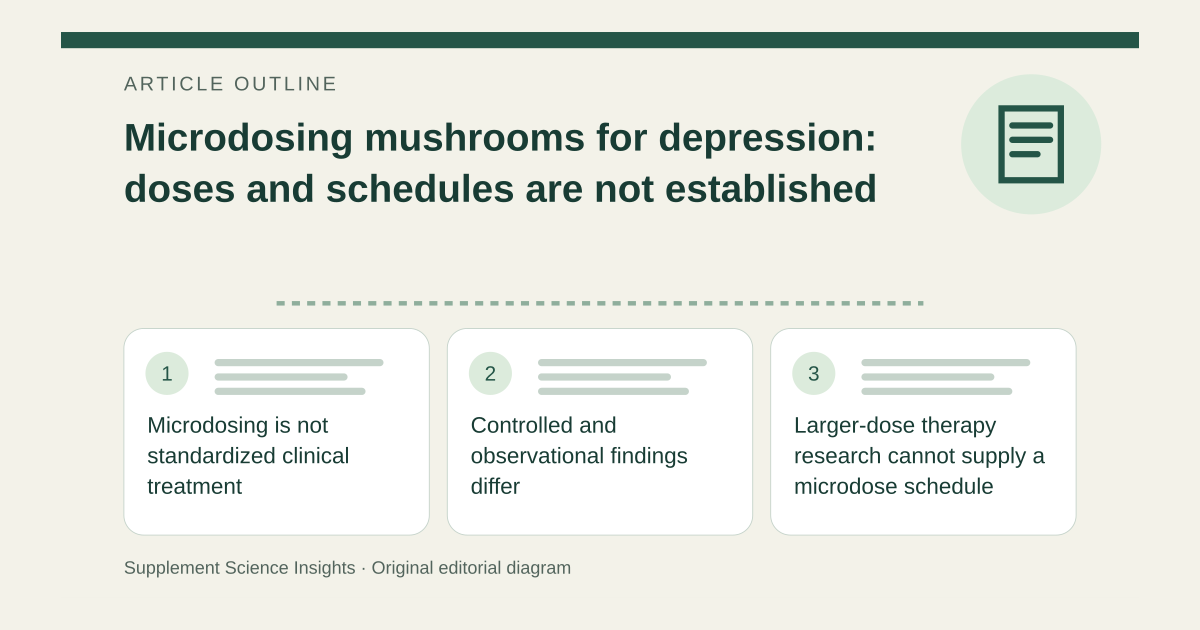
Microdosing is not standardized clinical treatment
The term generally refers to repeated very small psychedelic exposures, but products and informal schedules vary. Mushroom weight is not a precise psilocybin dose. NCCIH states that microdosing safety and effectiveness remain unclear. [1]
Controlled and observational findings differ
A 2026 systematic-review abstract covering healthy adults found no consistent immediate mood or symptom benefit in randomized evidence. Some observational studies reported improvement, but expectancy and lifestyle factors may contribute. Healthy-adult results are not trials establishing treatment for diagnosed depression. [2]
Larger-dose therapy research cannot supply a microdose schedule
A supervised depression protocol involving selected patients, psychological support and monitored dosing asks a different question. It cannot establish that an intermittent home routine is effective, safe or compatible with existing medication. [1]
Treat persistent depression as a clinical concern
Imagine someone chooses a schedule from a social-media testimonial and plans to stop prescribed treatment. The testimonial does not establish a therapeutic regimen. Discuss symptoms, medicines and research options with a clinician instead of making an unsupervised substitution. [1]
| Source | What it cannot establish |
|---|---|
| Online testimonial | Effective depression regimen |
| Healthy-adult study | Clinical depression treatment |
| Larger supervised dose | Microdose equivalence |
| Tiny mushroom portion | Known active dose |
Sources for this article
- Psilocybin for Mental Health and Addiction: What You Need To Know | NCCIH
Source consulted: 2026-09-21. This is a reference resource, not a claim that we conducted the studies or tested a product. - Efficacy and Safety of Psychedelic Microdosing on Psychological Outcomes in Healthy Adults: A Systematic Review and Meta-analysis.
Source consulted: 2026-09-21. This is a reference resource, not a claim that we conducted the studies or tested a product.