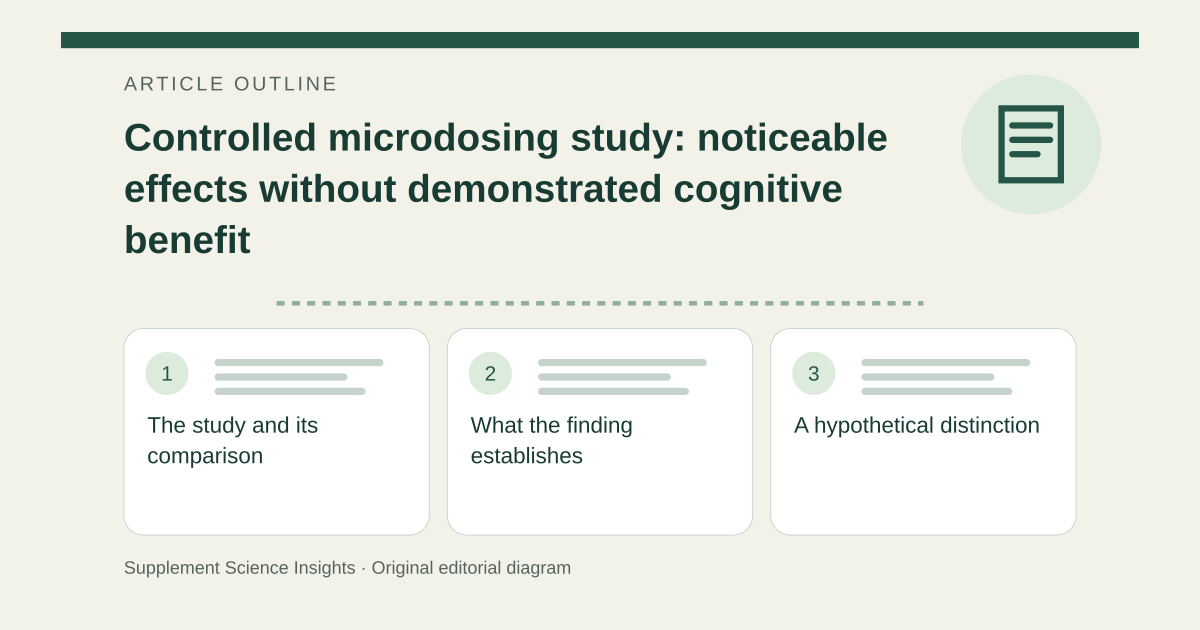
The study and its comparison
Thirty-four people planning to microdose participated in a blinded study comparing dried psilocybin-containing mushrooms with placebo. Researchers measured subjective effects, behavior, creativity, cognition and EEG activity. [1]
Subjective intensity increased mainly among participants who correctly identified their condition. EEG rhythms changed, but the experiment did not demonstrate the claimed wellbeing or cognitive improvements; a few measures shifted toward impairment. [1]
What the finding establishes
Expectancy and difficulty preserving blinding matter. The short experiment is not proof about every regimen, but anecdotes cannot override its null comparisons. Authors declared no competing interests; funding was not established from the abstract. It provides no dosing recommendation or assurance of safety. [1]
A hypothetical distinction
Imagine someone notices a drug effect. Noticing it is not the same as demonstrating better performance.
| Detail | Interpretation |
|---|---|
| Measured outcome | Keep the endpoint specific |
| Study preparation | Not every retail product |
| Remaining uncertainty | Not resolved by a mechanism |
Sources for this article
- Microdosing with psilocybin mushrooms: a double-blind placebo-controlled study.
Source consulted: 2026-09-19. This is a reference resource, not a claim that we conducted the studies or tested a product.