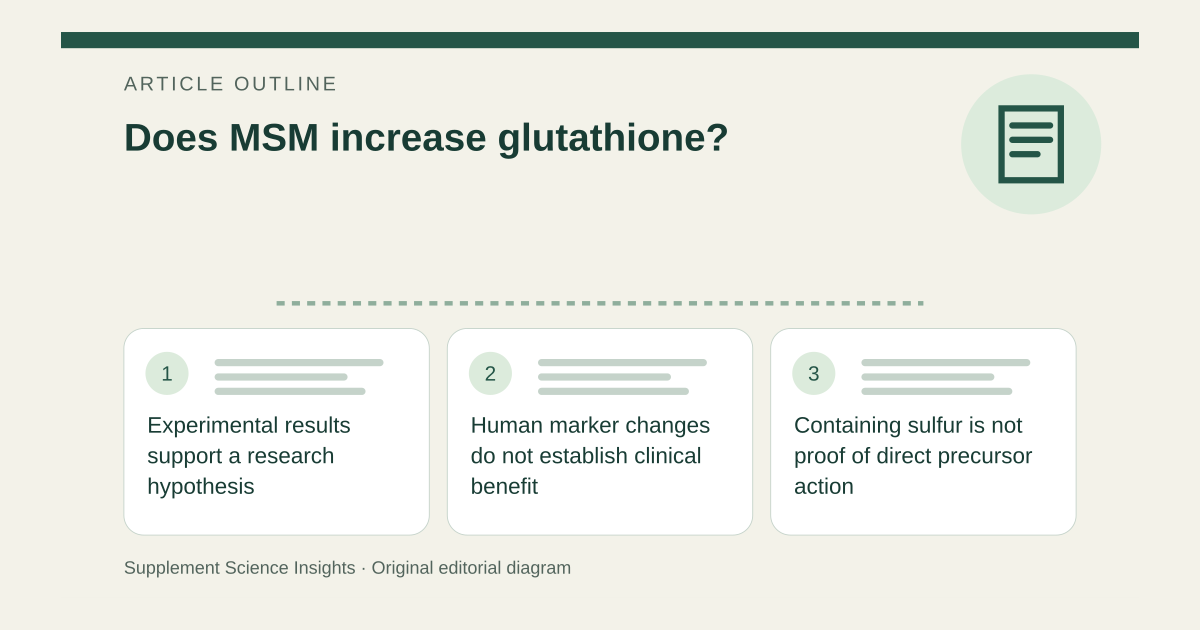
Experimental results support a research hypothesis
A review describes animal injury models in which MSM increased reduced glutathione or changed oxidative-stress markers. It also discusses cell experiments affecting the reduced-to-oxidized glutathione ratio. These settings do not reproduce normal supplement use in a healthy person. [1]
Human marker changes do not establish clinical benefit
The review includes limited exercise-related findings involving antioxidant capacity and oxidized glutathione. Such changes do not demonstrate correction of a diagnosed deficiency, better long-term health or a predictable increase in every tissue’s glutathione. [1]
Containing sulfur is not proof of direct precursor action
MSM is often described as a sulfur donor, but the review identifies unresolved metabolic questions. It should not simply be treated as equivalent to supplying the amino acids used in glutathione synthesis. One review author was employed by an MSM manufacturer and another had supplement-industry funding or consulting relationships. [1][2]
Do not choose a dose from an animal biomarker
Imagine an MSM product promises to double glutathione. Ask for human evidence for that exact dose, measurement and outcome. The reviewed material does not establish a universal dosing schedule to achieve that claim. [1]
| Measure | Distinction |
|---|---|
| Reduced GSH | One chemical pool |
| Oxidized GSSG | A different redox state |
| GSH/GSSG ratio | Not total concentration |
| Animal tissue change | Not a human health guarantee |
Sources for this article
- Methylsulfonylmethane: Applications and Safety of a Novel Dietary Supplement - PMC
Source consulted: 2026-09-21. This is a reference resource, not a claim that we conducted the studies or tested a product. - GLUTATHIONE SYNTHESIS - PMC
Source consulted: 2026-09-21. This is a reference resource, not a claim that we conducted the studies or tested a product.