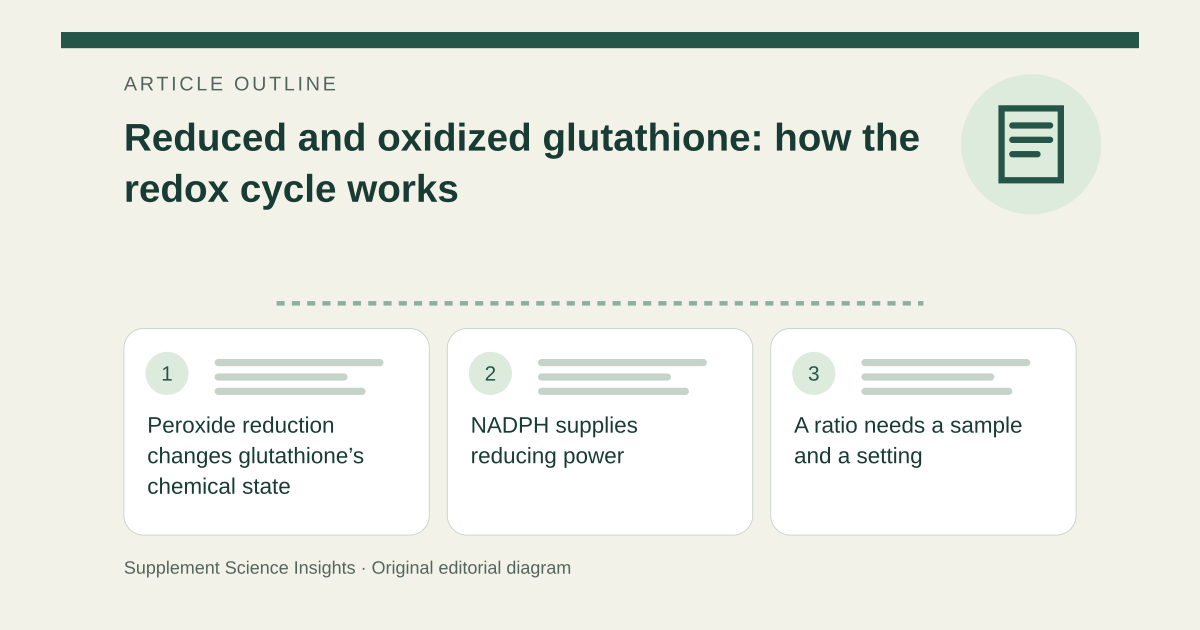
Peroxide reduction changes glutathione’s chemical state
Glutathione peroxidase helps reduce hydrogen peroxide and certain organic peroxides. In the process, reduced glutathione, abbreviated GSH, can form the oxidized disulfide GSSG. Two glutathione units are linked in this oxidized form. [1]
Reduced in this context is a chemical term, not a statement that the amount in a bottle has been lowered. Likewise, oxidized describes a state in a normal biochemical cycle rather than simply meaning that every molecule is useless waste. [1]
NADPH supplies reducing power
Glutathione reductase converts GSSG back to GSH using NADPH. The cycle therefore depends on enzymes and a source of reducing power, not only on the total amount of glutathione present. [1]
Recycling is different from synthesizing new glutathione from amino acids. Both processes can help maintain the pool, but they answer different questions: whether an existing molecule is restored to the reduced state, and whether new molecules are built. [1]
A ratio needs a sample and a setting
The balance of reduced and oxidized forms can inform redox research, but the compartment and measurement method matter. Severe oxidative stress can exceed recycling capacity; cells can also export oxidized material or form mixed disulfides with proteins. [1]
A product name containing reduced glutathione does not establish how much reaches a target tissue or whether a health outcome improves. A cellular cycle is not a direct dosing instruction. [1]
Total amount and chemical state are separate measurements
Imagine two samples contain a similar overall glutathione pool but different proportions of GSH and GSSG. Reporting only total glutathione would hide that distinction. Interpretation would still require knowing the sample type and experimental conditions.
| Observation | What it means |
|---|---|
| GSH | Reduced form |
| GSSG | Disulfide-oxidized form |
| NADPH and reductase | Support recycling |
Sources for this article
- Lu: Glutathione synthesis — foundational mechanistic review
Source consulted: 2026-09-17. This is a reference resource, not a claim that we conducted the studies or tested a product.