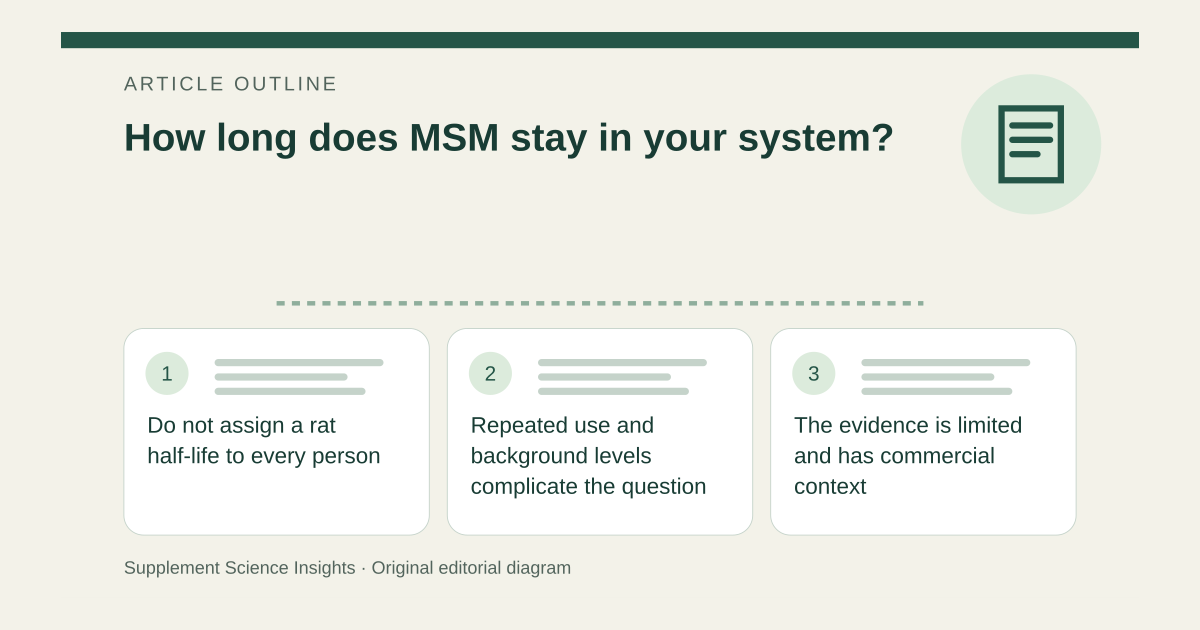
Do not assign a rat half-life to every person
A 2017 review reports an approximately 12.2-hour biological half-life in rats. It also discusses limited human estimates and different tissue measurements. Those observations should not be converted into a firm human washout schedule for any dose or formulation. [1]
Repeated use and background levels complicate the question
The review describes MSM as present at baseline and notes accumulation in a small repeated-intake human study. Dose history, diet and the measurement being used matter. A detectable background compound is different from a clinically active supplemental effect. [1]
The evidence is limited and has commercial context
The review includes authors with supplement-industry employment, consulting or research-funding ties. That does not invalidate its data, but reinforces the need to inspect the underlying methods and avoid precise claims unsupported by strong human pharmacokinetic studies. [1]
Use symptoms and clinical instructions for practical decisions
Imagine someone stops MSM because of a suspected reaction or before a procedure. Tell the clinician the product, dose and last use, rather than calculating safety from an animal half-life. Seek care for significant symptoms instead of waiting for a predicted clearance date. [2][1]
| Claim or question | Evidence boundary |
|---|---|
| Rat half-life | Not a universal human value |
| Repeated intake | Different from one dose |
| Detectable MSM | Not proof of ongoing benefit |
| Reaction or procedure | Follow clinical advice |
Sources for this article
- Methylsulfonylmethane: Applications and Safety of a Novel Dietary Supplement - PMC
Source consulted: 2026-09-21. This is a reference resource, not a claim that we conducted the studies or tested a product. - Dietary Supplements: What You Need to Know - Consumer
Source consulted: 2026-09-21. This is a reference resource, not a claim that we conducted the studies or tested a product.