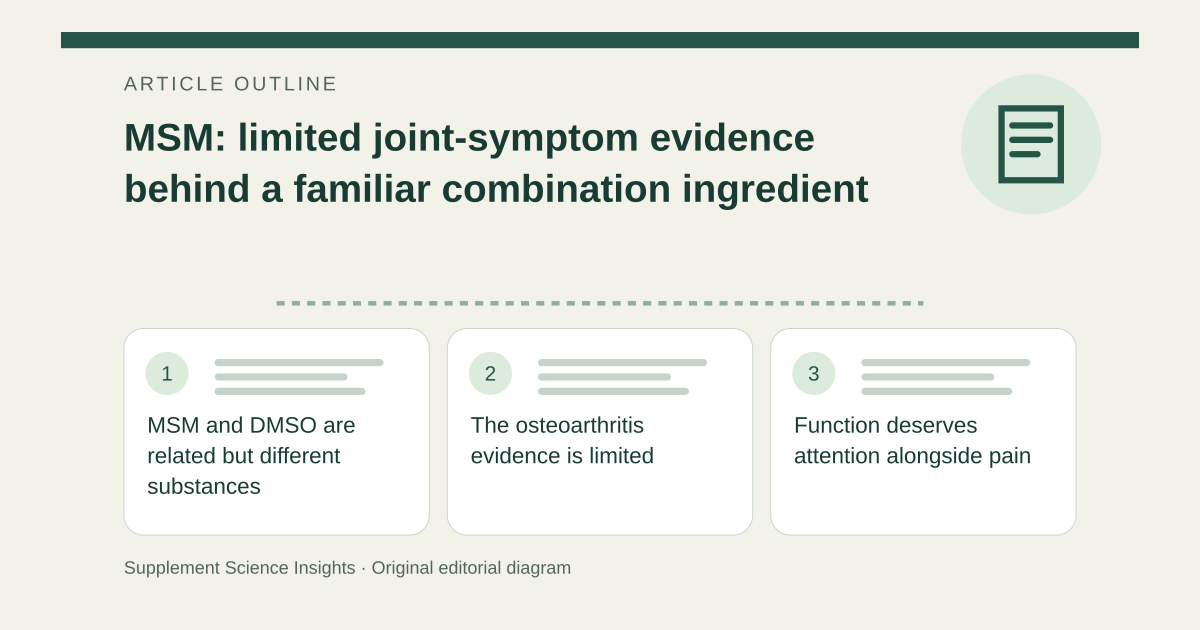
MSM and DMSO are related but different substances
MSM stands for methylsulfonylmethane and is used as a dietary supplement. DMSO, dimethyl sulfoxide, is a chemically related substance commonly discussed in topical contexts. A shared sulfur-related description does not make them interchangeable. [1]
Joint products often combine MSM with other ingredients. Record the amount and identity of each component before interpreting research. A trial of a combination cannot automatically establish that MSM accounts for the result or that an MSM-only product would reproduce it. [1]
The osteoarthritis evidence is limited
NCCIH describes too little research to determine whether MSM helps osteoarthritis symptoms. Small favorable findings require confirmation rather than a general conclusion that the ingredient reliably relieves pain or repairs joints. [1]
A source discussing both MSM and DMSO should be read carefully so that findings and adverse effects are assigned to the correct compound and route. Research interest is not the same as a demonstrated clinical benefit for a marketed preparation. [1]
Function deserves attention alongside pain
A joint study can measure pain at rest, discomfort during movement, walking, stairs or a questionnaire combining several domains. The most useful result identifies which of those changed. A lower score on one measure does not necessarily establish better performance in daily activities.
Look at the comparator and background care too. Exercise, physical therapy or other medicines may be used by both groups. An add-on result should retain those common interventions. It cannot support replacing them unless replacement was the actual question tested.
Limited evidence includes limits on safety confidence
MSM can cause digestive upset, allergic reactions or skin rash. A short study without serious events does not establish safety over years or in populations that were not enrolled. A multi-ingredient product also requires assessment of the other components. [1]
Discuss the complete formula and medicines with a clinician or pharmacist when considering it for ongoing symptoms. This page does not offer a dosing schedule or instructions for using related industrial or topical compounds. Route and product identity remain important safety boundaries. [1]
Convert units without inventing a treatment effect
Imagine a fictional serving lists 1.5 g MSM in three capsules. That is 1,500 mg per serving and 500 mg per capsule. A second product listing 500 mg per two-capsule serving contains 250 mg per capsule.
The first has more MSM per capsule, but that arithmetic does not establish better pain relief or tolerability. The comparison needs the serving definition before any discussion of quantity.
| Fictional label | Per capsule |
|---|---|
| 1.5 g per three capsules | 500 mg |
| 500 mg per two capsules | 250 mg |
| More ingredient | Not necessarily more benefit |
A useful comparison can end with uncertainty
This overview does not recommend MSM for arthritis or equate it with DMSO. It explains why correct composition, unit conversion and a plausible mechanism still leave the clinical question open. Persistent joint symptoms should be assessed on their own merits rather than assumed to require a sulfur-containing supplement.
Sources for this article
- NCCIH — Osteoarthritis: in depth, MSM section
Source consulted: 2026-09-17. This is a reference resource, not a claim that we conducted the studies or tested a product.