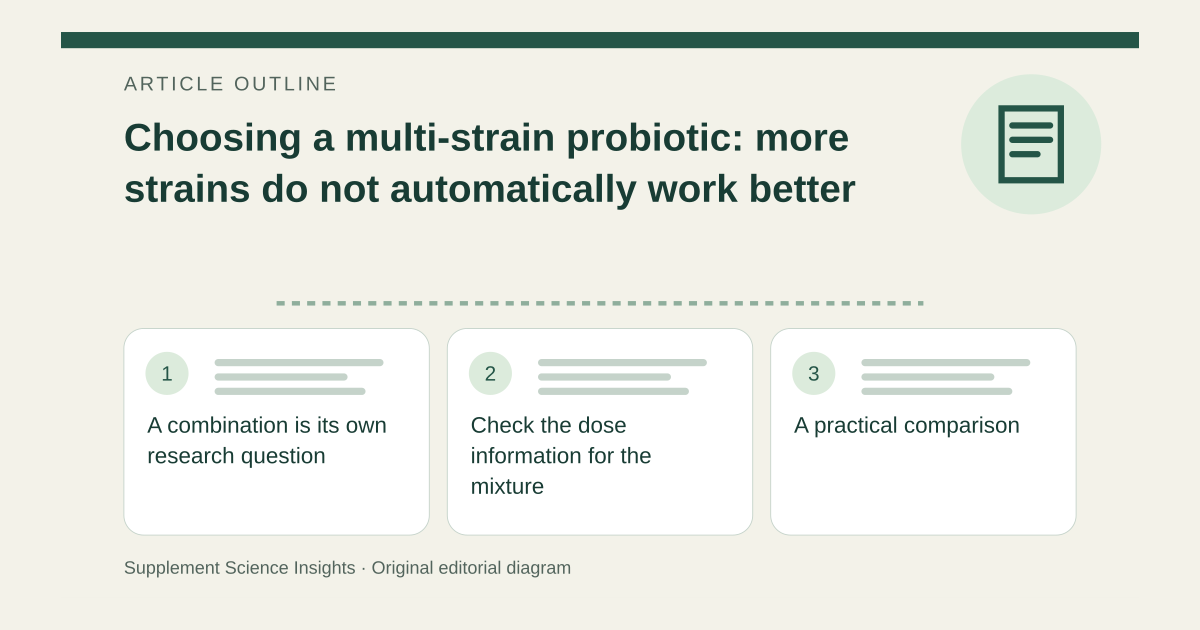
A combination is its own research question
If a trial tests a defined blend, interpret it as evidence for that preparation under those conditions. Findings for individual strains do not automatically add up when mixed, and a product with one extra organism is no longer identical to the tested formula. ODS emphasizes formulation-specific interpretation. [1]
Check the dose information for the mixture
A total CFU number may not state how much of each strain is supplied. Check the identifiers, declared counts, use-by basis and storage directions. These details help connect the label to evidence, but a high count alone does not establish superiority over a smaller, better-studied preparation. [1]
A practical comparison
Imagine a five-strain blend matches a relevant trial and a twenty-strain blend offers only generic gut-health claims. The larger number does not settle the choice in its favor. Review the actual outcome and safety context, especially for people who are severely ill or immunocompromised, rather than selecting by strain count alone. [1]
| Example | Interpretation |
|---|---|
| Blend tested in a trial | Defined intervention |
| Extra strains | Change the formulation |
| Larger total count | Not automatic superiority |
Sources for this article
- Probiotics - Health Professional Fact Sheet
Source consulted: 2026-09-20. This is a reference resource, not a claim that we conducted the studies or tested a product.