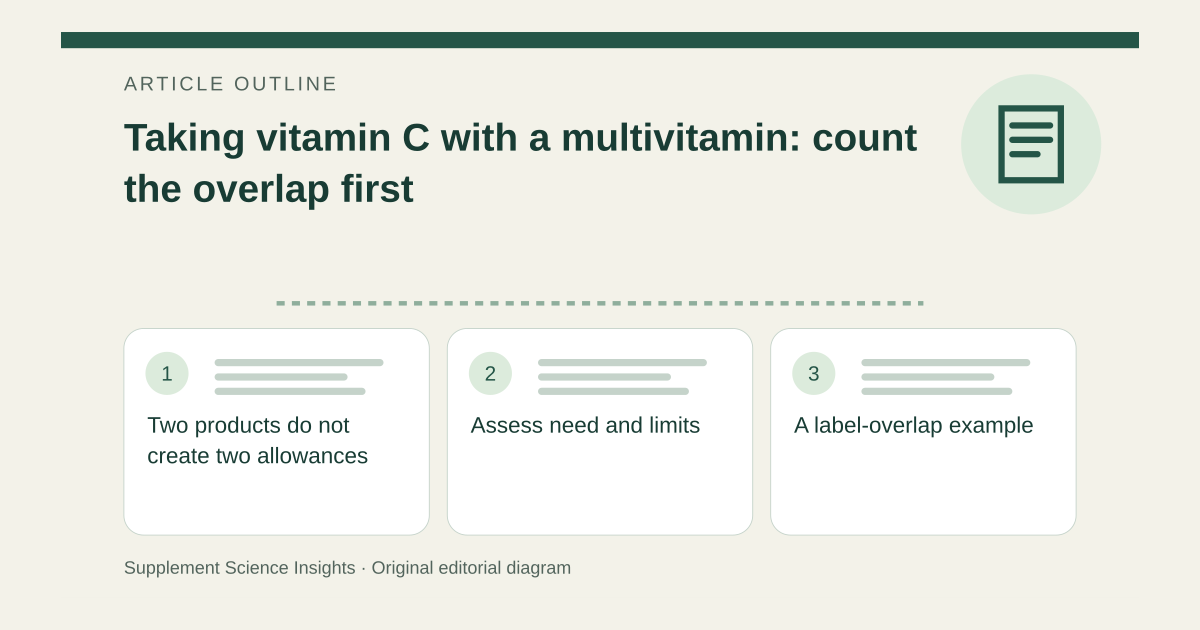
Two products do not create two allowances
A multivitamin may already supply vitamin C. Adding a separate tablet increases the total exposure; it does not create an independent requirement for each product. Read the amount per serving and how many servings you take. Food and fortified drinks also contribute. [1]
Assess need and limits
The usual adult vitamin C RDA is 75 mg for women and 90 mg for men, with life-stage and smoking adjustments. The adult upper limit is 2,000 mg daily from all sources, not a goal. Gastrointestinal symptoms can occur with high intakes, and kidney or iron-overload disorders can require specific advice. Combining products is not automatically necessary just because their totals fall below that limit. [1]
A label-overlap example
Suppose a multivitamin supplies 90 mg and a separate tablet 500 mg. Together that is 590 mg before food. Replacing the tablet with a 2,000 mg version raises the supplement subtotal to 2,090 mg, already above the adult upper limit. This arithmetic helps identify duplication; it does not select a personal regimen. [1]
| Hypothetical combination | Supplement subtotal |
|---|---|
| 90 mg multivitamin +500 mg tablet | 590 mg |
| 90 mg multivitamin +2,000 mg tablet | 2,090 mg |
| Food and fortified drinks | Additional vitamin C, not included above |
Sources for this article
- Vitamin C - Health Professional Fact Sheet
Source consulted: 2026-09-20. This is a reference resource, not a claim that we conducted the studies or tested a product.