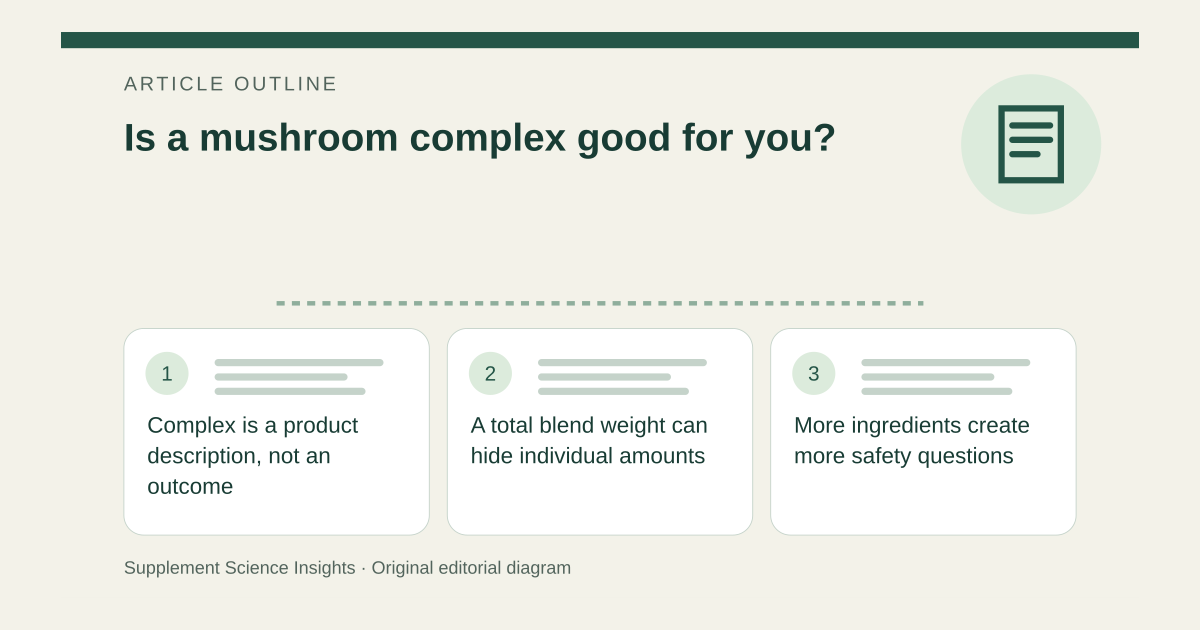
Complex is a product description, not an outcome
Products may combine lion’s mane, reishi, cordyceps, turkey tail or other ingredients. OPSS notes variation in quality, purity and preparation, with little information about how multiple-mushroom combinations interact in the body. [1]
A total blend weight can hide individual amounts
If a label lists only the combined mass, it may not reveal how much of each preparation is present. Even a disclosed amount does not prove equivalence to a study using a particular extract. [1][2]
More ingredients create more safety questions
Gastrointestinal symptoms and allergic reactions are possible. Reishi can raise bleeding or treatment concerns, and chaga has kidney-injury reports. A wellness purpose does not make a combination suitable with every medicine or condition. [1][3][4]
Ask whether the complete formula was tested
Imagine a blend cites separate studies on three different extracts but no study of the actual product. That leaves the combined effect uncertain. Choose based on a defined need and suitable evidence rather than ingredient count. [2]
| Label feature | Question |
|---|---|
| Ten mushrooms | Why these together? |
| Proprietary blend | What amount of each? |
| Study references | Same preparation and formula? |
| Quality seal | Identity testing, not proof of benefit |
Sources for this article
- Mushroom Dietary Supplements
Source consulted: 2026-09-21. This is a reference resource, not a claim that we conducted the studies or tested a product. - Dietary Supplements: What You Need to Know
Source consulted: 2026-09-21. This is a reference resource, not a claim that we conducted the studies or tested a product. - Reishi Mushroom | Memorial Sloan Kettering Cancer Center
Source consulted: 2026-09-21. This is a reference resource, not a claim that we conducted the studies or tested a product. - Chaga Mushroom | Memorial Sloan Kettering Cancer Center
Source consulted: 2026-09-21. This is a reference resource, not a claim that we conducted the studies or tested a product.