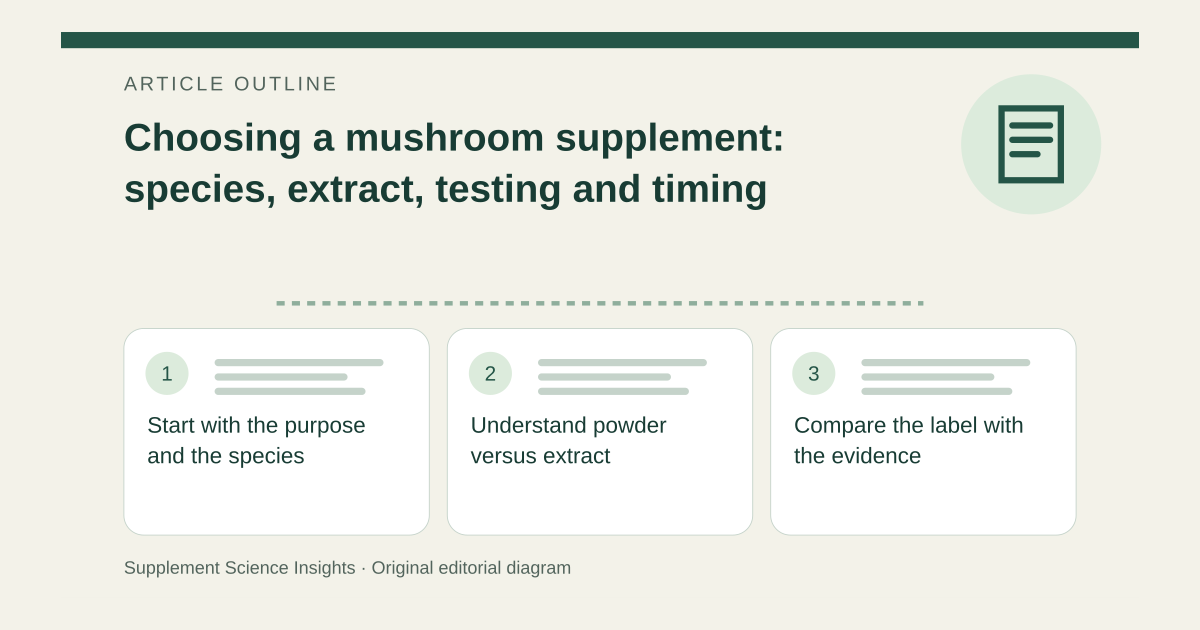
Start with the purpose and the species
OPSS describes lion’s mane, reishi, cordyceps and other functional mushrooms sold for memory, energy, immunity and similar goals, while noting limited evidence beyond food use. MSK identifies preliminary human findings for some specific preparations. Neither a traditional use nor evidence for one species establishes a benefit for a multi-mushroom blend. [1][2]
Understand powder versus extract
A powder may contain dried fruiting body or mycelium. An extract is a preparation obtained by processing mushroom material to collect selected components; its composition depends on that process. Capsules, powders and liquid products describe delivery forms, not equivalent doses. Check what the label actually identifies rather than assuming every gram has the same composition. [1]
Compare the label with the evidence
Look for the species, mushroom material, amount per serving and other ingredients. If a study concerns a particular extract, a generic blend is not automatically the studied preparation. A ratio or a prominently advertised compound amount cannot by itself demonstrate a clinical benefit. [1][3]
Quality testing has a specific job
Independent quality testing can help assess identity, declared contents and contaminants; it does not establish that a supplement prevents disease or is suitable with your medicines. A product with vague ingredients or cure claims is a poor basis for an informed choice. [3]
When and how to take it
The inspected guidance does not establish a universal morning, nighttime or empty-stomach rule for mushroom supplements. If use is appropriate, follow the particular product directions and review tolerance and interactions. A coffee blend’s caffeine and a sleep blend’s other ingredients matter; changing the clock does not correct a risky combination or an unsupported treatment claim. [1][3]
Make a like-for-like comparison
Imagine one bottle lists a named single-species preparation and another lists a proprietary blend. The larger total milligram number does not settle which fits the intended use. Compare the actual ingredients and evidence, then decide whether there is a reason to take either product. [1][3]
| Label item | Why it matters |
|---|---|
| Species and material | Defines the ingredient |
| Serving amount | Avoids capsule-versus-serving confusion |
| Other ingredients | Changes safety and timing |
| Quality testing | Does not prove effectiveness |
Sources for this article
- Mushroom Dietary Supplements
Source consulted: 2026-09-21. This is a reference resource, not a claim that we conducted the studies or tested a product. - Lion's Mane Mushroom | Memorial Sloan Kettering Cancer Center
Source consulted: 2026-09-21. This is a reference resource, not a claim that we conducted the studies or tested a product. - Dietary Supplements: What You Need to Know
Source consulted: 2026-09-21. This is a reference resource, not a claim that we conducted the studies or tested a product.