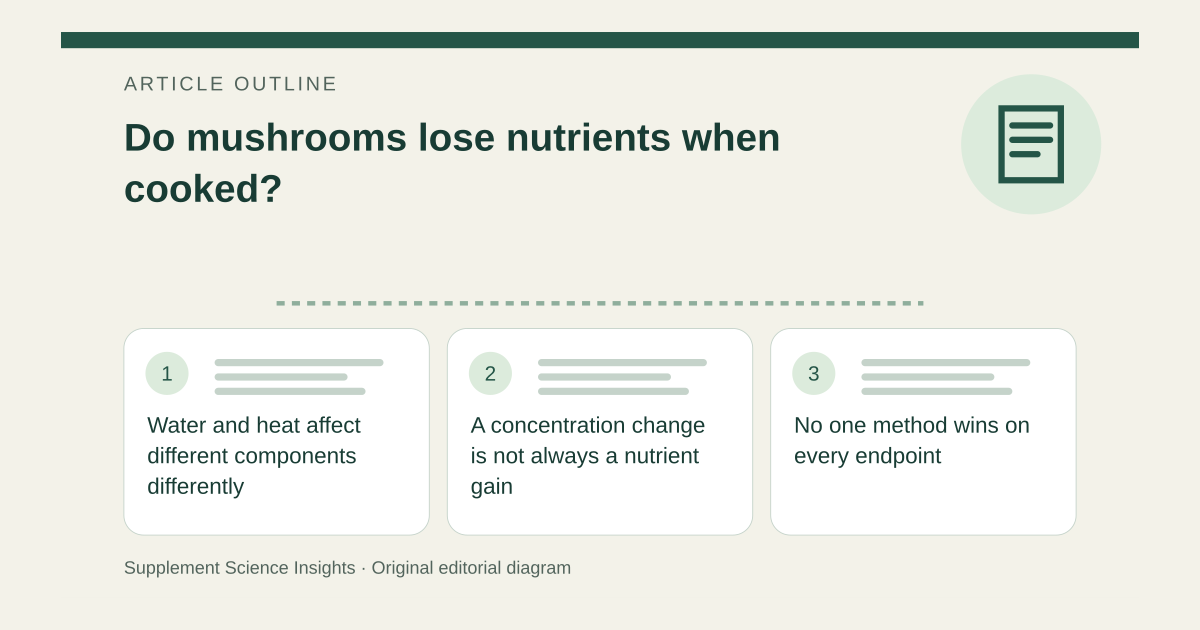
Water and heat affect different components differently
A processing review describes losses of some soluble components with boiling and changes in measured antioxidant activity across methods. Minerals are not destroyed by ordinary cooking, but can move into discarded liquid. Retaining a broth changes that calculation. [1]
A concentration change is not always a nutrient gain
If cooked mushrooms contain less water, a value per 100 g may rise even without more total nutrient in the starting batch. Conversely, a larger water content can dilute a measured value. Compare equivalent starting portions and what is actually eaten. [1]
No one method wins on every endpoint
The review summarizes differences among boiling, frying, grilling and microwaving. A laboratory antioxidant assay does not establish which meal produces better long-term health. Frying can increase fat and energy even when some measured compounds remain. [1]
Keep safety and the whole recipe in view
Imagine a soup retains the cooking liquid, while boiled mushrooms are drained. Those meals retain different amounts of leached material. Choose a suitable cooking method for the edible species and account for sauces, oil and salt rather than chasing one laboratory number. [2][3]
| Observation | Possible explanation |
|---|---|
| More nutrient per 100 g | Water loss |
| Less in drained mushrooms | Leaching into liquid |
| Higher fat after frying | Added cooking oil |
| Higher antioxidant assay | Not proof of better clinical outcome |
Sources for this article
- Edible Mushrooms: A Comprehensive Review on Bioactive Compounds with Health Benefits and Processing Aspects - PMC
Source consulted: 2026-09-21. This is a reference resource, not a claim that we conducted the studies or tested a product. - Fruit and Vegetable Guide Series: Mushrooms | USU
Source consulted: 2026-09-21. This is a reference resource, not a claim that we conducted the studies or tested a product. - Preventing Listeria Infection | Listeria Infection | CDC
Source consulted: 2026-09-21. This is a reference resource, not a claim that we conducted the studies or tested a product.