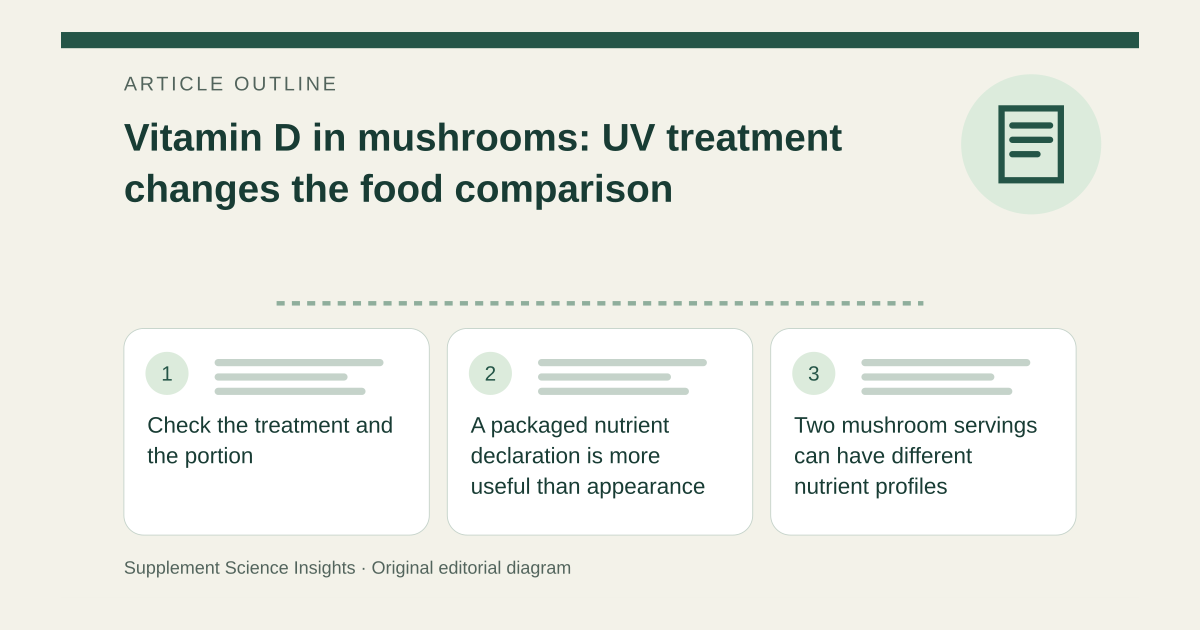
Check the treatment and the portion
NIH ODS describes UV treatment as a way to increase mushroom vitamin D2. Its table lists 9.2 micrograms per half cup for a particular UV-exposed white-mushroom entry, compared with much less in an untreated portabella entry. [1]
Those entries differ in mushroom type and preparation as well as UV history. They are food-composition examples, not a controlled experiment isolating the effect of UV exposure. Avoid turning their ratio into a precise treatment-effect estimate. [1]
A packaged nutrient declaration is more useful than appearance
A mushroom’s appearance does not provide a reliable vitamin D dose. Use the labeled amount when available and the matching food-table description when estimating. Mushrooms are fungi, even when grouped with plant-based foods for meal planning. [1]
The ODS summary does not establish a home sunlight or UV-lamp protocol that yields a predictable amount. It also does not justify using a raw-food value unchanged for every cooked portion, where weight and preparation differ. [1]
Two mushroom servings can have different nutrient profiles
Imagine a recipe swaps a labeled UV-treated product for ordinary mushrooms. The original vitamin D estimate should be recalculated, not carried over solely because both ingredients are mushrooms.
| Detail | Meaning |
|---|---|
| UV-treated | Can have higher D2 |
| Food-table comparison | Not a controlled trial |
| Home treatment | No predictable dose established here |
Sources for this article
- NIH ODS: Vitamin D
Source consulted: 2026-09-17. This is a reference resource, not a claim that we conducted the studies or tested a product.