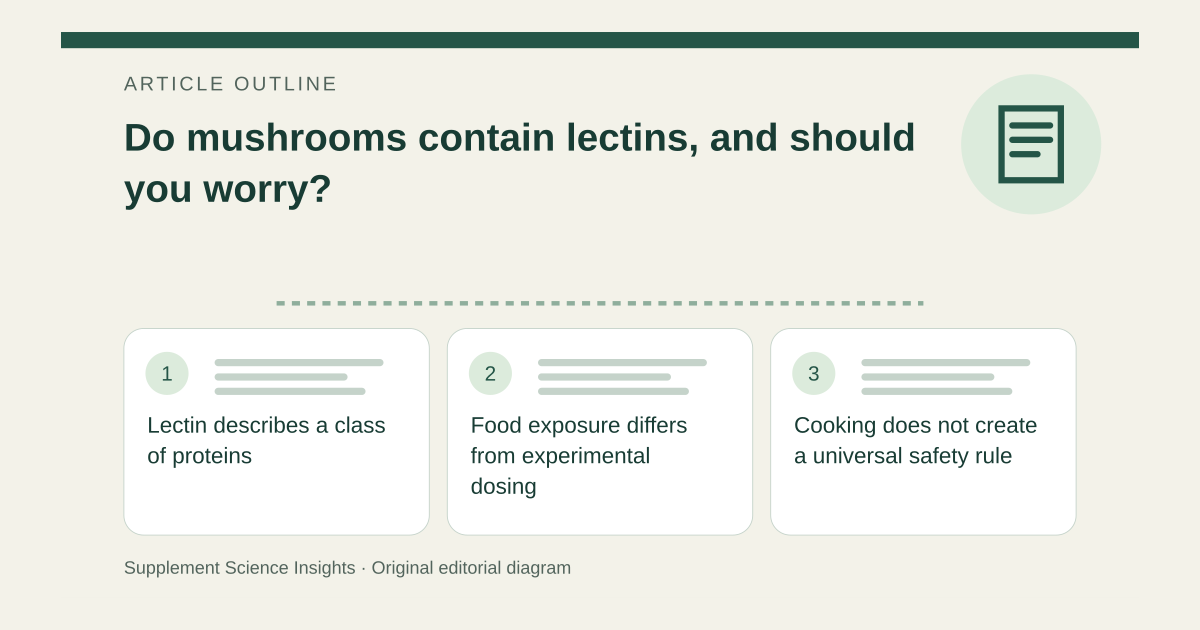
Lectin describes a class of proteins
A review of edible-mushroom proteins describes lectins with different structures and biological activities. A laboratory result involving one purified lectin cannot be applied to every mushroom or every serving. [1]
Food exposure differs from experimental dosing
Experiments may use concentrated proteins, cells or animals and routes unrelated to eating cooked food. Such work can identify mechanisms or hazards, but does not establish that avoiding all mushroom lectins improves human health. [1][2]
Cooking does not create a universal safety rule
Processing affects mushroom proteins and other components, but not every toxin is reliably eliminated by heat. Correct species identification and appropriate preparation remain more important than assuming any mushroom becomes safe after cooking. [2]
Assess an actual reaction rather than a broad label
Imagine a person develops symptoms after a mushroom dish. Consider the species, storage, preparation, other ingredients and possible allergy or intolerance. The word lectin alone does not identify the cause or justify a permanent broad restriction. [1][3]
| Information | Limit |
|---|---|
| Lectin detected | Not proof of food harm |
| Purified-protein experiment | Different exposure |
| Cooking | Not a cure for unknown toxicity |
| Symptoms after a dish | Need a specific assessment |
Sources for this article
- Proteins from Edible Mushrooms: Nutritional Role and Contribution to Well-Being - PMC
Source consulted: 2026-09-21. This is a reference resource, not a claim that we conducted the studies or tested a product. - Edible Mushrooms: A Comprehensive Review on Bioactive Compounds with Health Benefits and Processing Aspects - PMC
Source consulted: 2026-09-21. This is a reference resource, not a claim that we conducted the studies or tested a product. - FODMAP food list | Monash FODMAP - Monash Fodmap
Source consulted: 2026-09-21. This is a reference resource, not a claim that we conducted the studies or tested a product.