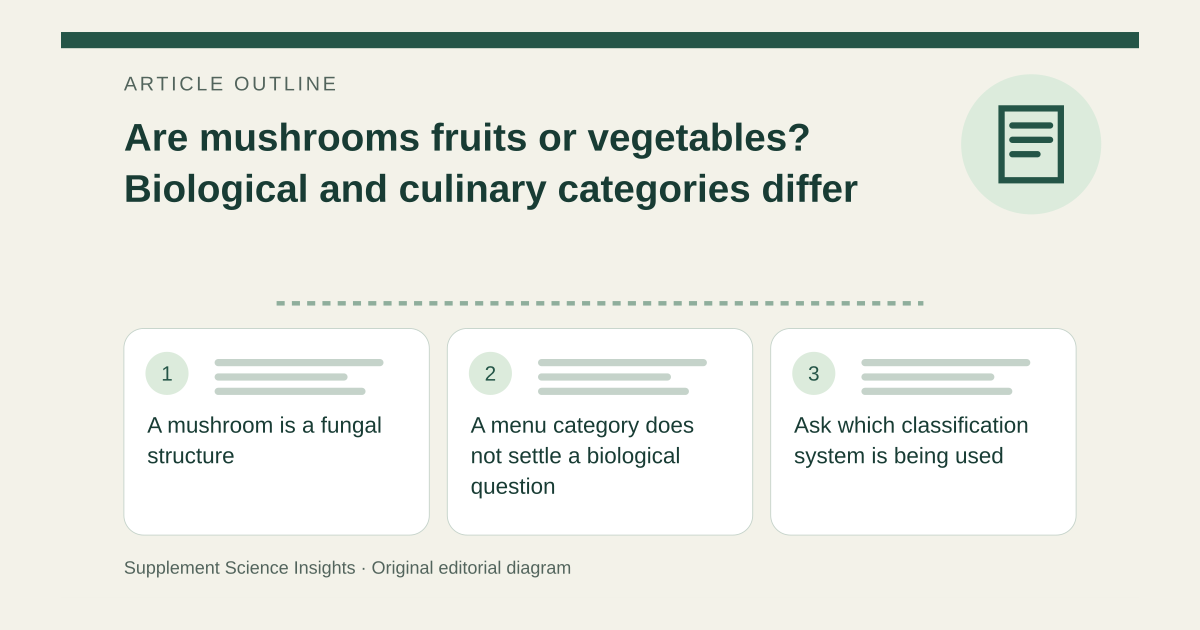
A mushroom is a fungal structure
Kew explains that fungi occupy their own kingdom and obtain nutrition differently from photosynthetic plants. Fungal cells lack chlorophyll, and their cell-wall composition also differs from that of plants. [1]
Many familiar mushrooms are fruiting bodies of a larger fungus. Here, fruiting body is a biological term for a reproductive structure, not a claim that the organism is a flowering plant bearing fruit. [1]
A menu category does not settle a biological question
In a recipe, mushrooms may be grouped with vegetables for practical purposes. That culinary grouping does not change their classification or establish that they have the same nutrient profile as the vegetables beside them. [1]
Likewise, describing a product as mushroom-derived identifies a broad source, not its exact species, plant-free processing history or clinical effects. Food classification and product-composition questions need their own evidence; the kingdom name cannot answer them by itself. [1]
Ask which classification system is being used
Imagine a shopping list places mushrooms under vegetables. That can be convenient for shopping while remaining different from the biological statement that the organism belongs to the fungal kingdom.
| Detail | Interpretation |
|---|---|
| Fungi | Biological kingdom |
| Fruiting body | Reproductive structure |
| Vegetable grouping | Culinary convention |
Sources for this article
- What in earth? Understanding what fungi really are | Kew
Source consulted: 2026-09-19. This is a reference resource, not a claim that we conducted the studies or tested a product.